
Key Summary
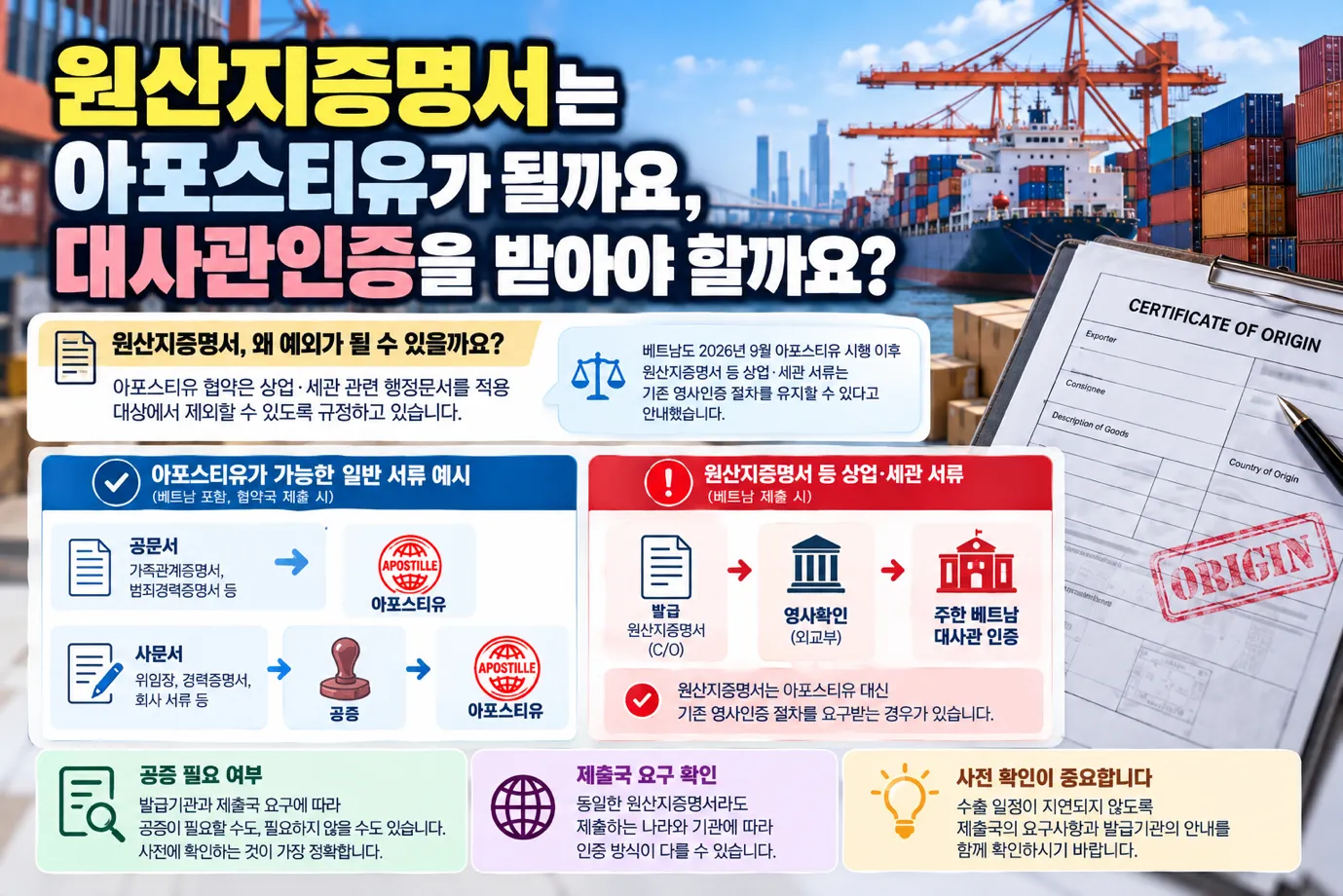
- ExceptionSince the certificate of origin can be classified as an administrative document related to commerce and customs, consular authentication and embassy authentication may be required even if it is a contracting country.
- VietnamIt was announced that these documents will maintain the existing consular certification even after the implementation of Apostille in September 2026.
- NotarizationWhether notarization is required varies depending on the issuing agency, so you must check the submission country request and issuing agency together.
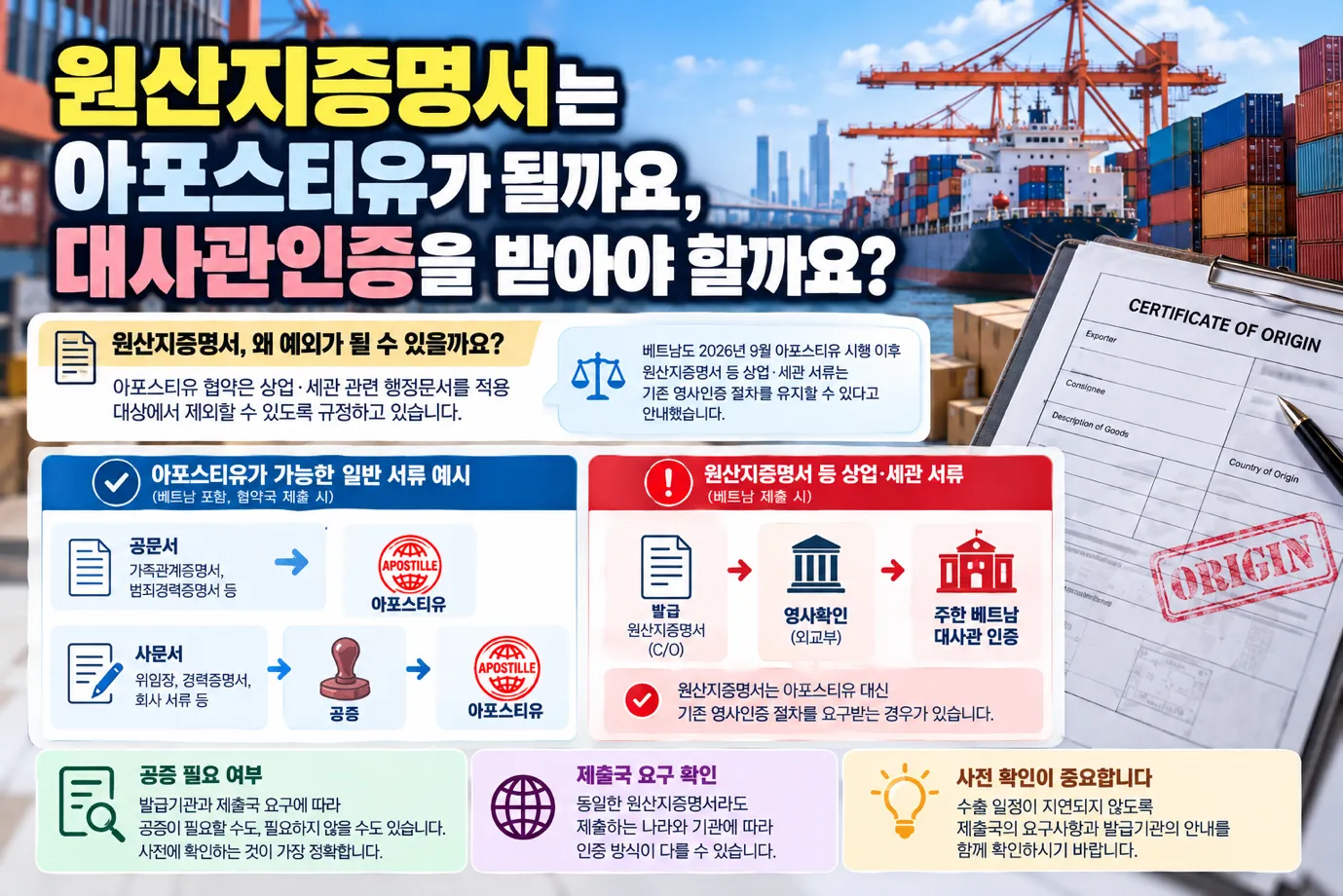
There are frequently asked questions. “The exporting country is an Apostille Convention country, so I just need to get an Apostille certificate of origin, right?”
Most export documents are like that. However, the certificate of origin is a representative document that can be an exception. In fact, there are cases where the power of attorney or corporate documents are completed with an Apostille, but only the certificate of origin is required for embassy authentication, causing delays in the schedule.
Let’s take a look at why a certificate of origin can be an exception, how it is authenticated, and when notarization is necessary.
Processing path for each situation
| Situation | Processing Path |
|---|---|
| Submitting country is not a member country (UAE, Egypt, Qatar, etc.) | Consular authentication → Certification by the embassy of the relevant country in Korea |
| In case of a contracting country and receiving an Apostille on the certificate of origin | Apostille |
| In case of a contracting country but requires consular authentication as a commercial/customs document (e.g. Vietnam) | Consular authentication → Authentication by the embassy of the relevant country in Korea |
| When local language translation is required | Notarize both the translation and the original (or a copy of the original) and then authenticate using the above route. |
Why can a certificate of origin be an exception?
Article 1 of the Apostille Convention specifies documents to which the convention does not apply. One of them is administrative documents directly related to commercial or customs affairs. Since the certificate of origin is a document used for customs clearance and tariff application, there is room for it to fall into this category.
The Hague Conference on Private International Law recommends that this exception be interpreted as narrowly as possible. However, how the documents are actually accepted is determined by the institutions of the country receiving the documents. So, even in the same agreement, there are countries that accept Apostille on the certificate of origin, and there are still countries that require consular authentication.
Vietnam is a representative example
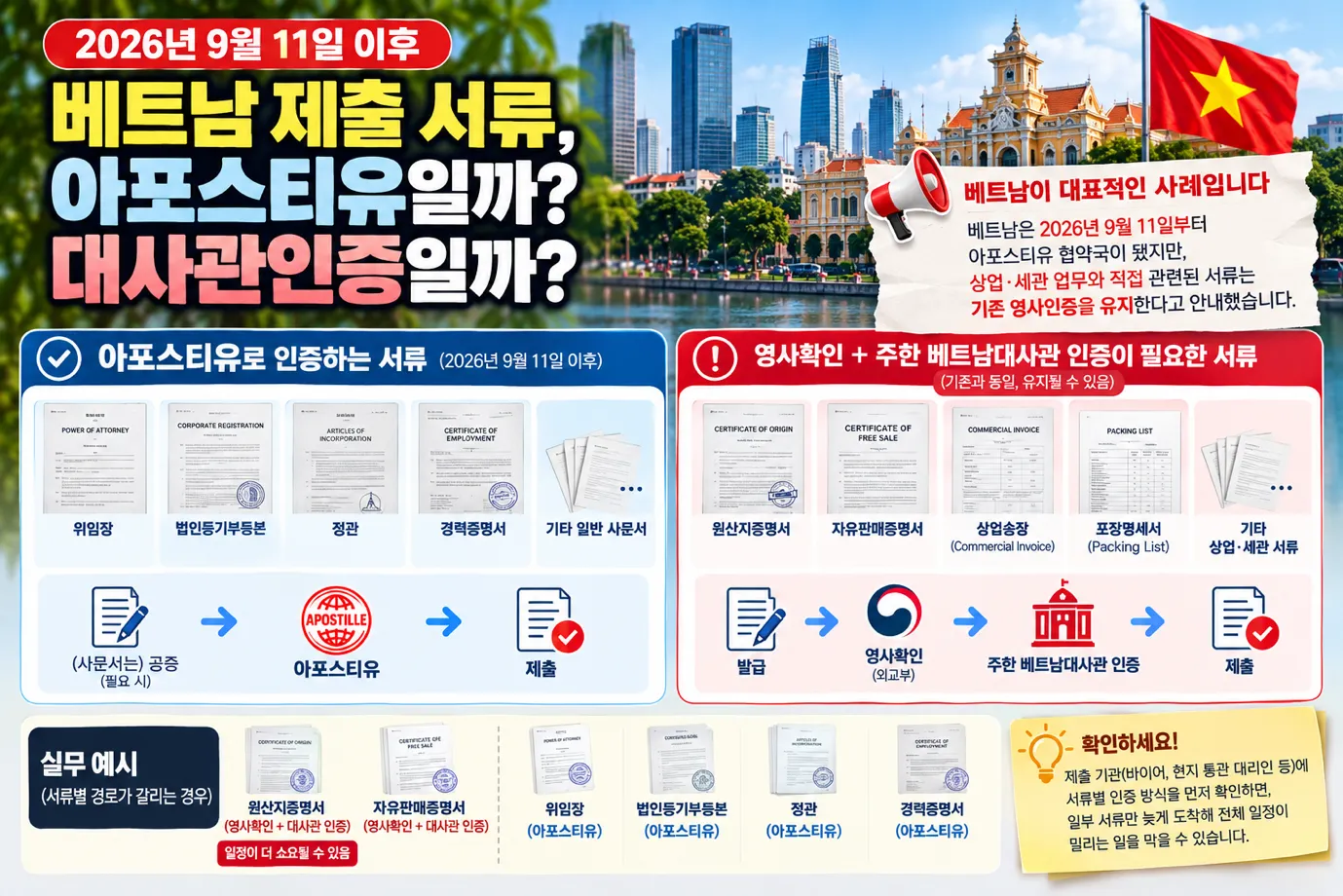
Vietnam became an Apostille Convention country starting September 11, 2026. However, the Vietnamese Embassy in the U.S. announced in its enforcement notice that existing consular authentication will be maintained for documents directly related to commercial and customs duties.
So, if you are a company exporting to Vietnam, you must view the documents separately. Documents such as power of attorney, corporate register, and articles of incorporation have changed to Apostille, but certificates of origin may still require consular authentication and certification from the Vietnamese Embassy in Korea. It is best to first check with the buyer or local customs agent about the certificate of origin authentication method before starting.
What often happens in practice is when paths diverge within the same bundle. When sending a certificate of origin, certificate of free sale, and power of attorney together, the power of attorney and corporate documents go through Apostille, and only the certificate of origin goes through consulate confirmation and embassy authentication. If you separate routes for each document first, you can prevent the overall schedule from being pushed back due to some documents arriving late.
Whether notarization is required depends on the issuing institution.
Apostille and consular authentication are attached immediately to official documents, and to private documents they are attached after notarization. Since there are multiple issuing organizations for the certificate of origin, this classification varies depending on the document.
Starting July 22, 2024, the certificate of origin issued by the Korea Cosmetic Association can be applied for Apostille and consular authentication without notarization. Notarization was also omitted for the same association's manufacturing and sales certificate, manufacturing certificate, manufacturer's certificate, responsible seller certificate, and address change certificate. Since then, the Office of Overseas Koreans has expanded the scope of exemption from notarization to include original certificates of trade secrets (September 2025) and documents from public medical institutions designated by the Ministry of Health and Welfare (December 2025).
There is practical guidance that certificates of origin issued by the Chamber of Commerce are accepted without separate notarization. However, processing may vary depending on whether it is an original or a printed copy issued electronically, so it is safer to check before submitting.
Frequently Asked Questions
Q. If you send it to a contracting country, isn't the certificate of origin necessarily an Apostille?
No. A certificate of origin can be classified as a commercial or customs-related document, so even countries that have signed agreements may require consular authentication and embassy authentication.
Q. What should I do now for the certificate of origin sent to Vietnam?
Commercial and customs documents are advised to maintain existing consular authentication, so consular authentication and Vietnamese Embassy in Korea authentication may be required. Check the buyer's requirements first.
Q. Does the Cosmetics Association’s certificate of origin need to be notarized?
Starting July 22, 2024, you can apply for Apostille or consular authentication without notarization.
Q. Can I process the certificate of origin and certificate of free sale at once?
Even if sent to the same country, the authentication path may be different for each document. You can shorten the schedule by first organizing the route for each document and then submitting them all at once.
Conclusion
The certificate of origin is a document that can retain embassy authentication even in the Apostille era. Don't just look at the status of the submission country's agreement, but also check how that country receives the certificate of origin and whether notarization is required by the issuing agency to avoid messing up your schedule.
Nanum Global divides export documents by country and document, organizes the Apostille, consular authentication, and embassy authentication routes and processes them all at once. Please let us know the country you are sending to and the list of documents, and we will reply with a list of which documents should go which route.
Are you confused about the certificate of origin certification path?
If you tell us the country you are sending to and the list of documents, we will guide you by document, whether it is Apostille or Embassy authentication.


