

Key Summary
- ChangeThe member countries of the Apostille Convention keep changing. Representative countries include China (November 2023), Vietnam (September 11, 2026), and Saudi Arabia (2022).
- DangerIf you only rely on past experience and prepare for embassy authentication or assume that you only need to receive an Apostille, your documents may not work.
- PreventionBefore starting the document, please check the current subscription/effectiveness status of the submitting country.
- CautionDuring the transition period, the procedures before and after the enforcement date differ, so it is safe to schedule with plenty of time.
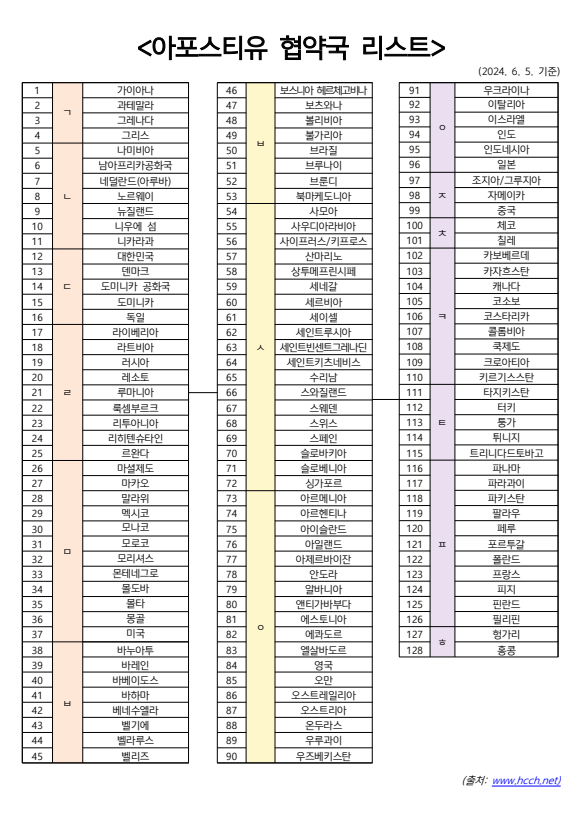
There are frequently asked questions. “Last year, this country received embassy accreditation. Is it the same this year?”
It may not be the same. The number of countries that have joined the Apostille Convention is not fixed and continues to increase. So, countries that received embassy certification last year have changed to Apostille this year.
This illusion actually causes accidents in practice. In this article, we will summarize what changes have occurred in recent years and which countries are prone to confusion.
Countries that have recently changed
First, let’s point out recent changes.
In China, the Apostille Convention came into effect on November 7, 2023. Until then, you had to go through both Ministry of Foreign Affairs consular authentication and Chinese Embassy authentication in Korea, but now it only takes one step: Apostille. The consular authentication service at the Chinese Embassy in Korea has been abolished.
Vietnam will become a party to the convention from September 11, 2026. Cases received before that will go through the existing consular authentication and embassy authentication, and cases received after that will be processed through Apostille. Since the procedures differ before and after the enforcement date, special caution is required during this period.
Saudi Arabia joined in December 2022. Since it is the Middle East, embassy authentication may be required, but since it is a signatory to the convention, it is processed through Apostille. However, since it is a transition period, some Saudi government agencies or employers may still require additional verification in the old way, so it is safer to check with the submission source in advance.
A country that is easy to confuse
There are countries where it is easy to make a mistake if you only look at the region.
In the Middle East, Türkiye, Israel, Morocco, Saudi Arabia, and Qatar are signatories to the convention. Since it is geographically the Middle East, it is easy to think of embassy authentication, but it is processed with Apostille. On the other hand, UAE, Iraq, Iran, and Egypt in the Middle East are not member countries and require consular authentication and embassy authentication. If you think of the Middle East as one thing, you are half wrong.
The same goes for Asia. India has been a member since 2005, and Kazakhstan has been a member since 2001. Russia is also a member country. On the other hand, Thailand has not yet come into effect. Although the cabinet approved the accession process in December 2025, it is currently not a member state as the accession documents have not been officially deposited. Therefore, documents submitted to Thailand still follow the consular authentication process.
What happens if you make a mistake?
Problems that occur vary depending on the direction.
If you prepare for embassy authentication thinking you are from an unregistered country, when you go to the embassy, you will be told that they do not do that work. China is a representative example. In this case, it will be a waste of time and you will have to go to the Ministry of Foreign Affairs again. Fortunately, the document itself is alive and can be received back with an Apostille.
The opposite is more difficult. I thought it was a member country and only received an Apostille and sent it, but it turned out to be a non-member country. In this case, the documents will not be accepted locally and will be rejected, and you will have to go through the consulate confirmation and embassy authentication procedures all over again. If documents have already been sent overseas, they must be retrieved or new ones issued, resulting in significant loss of time and money.
In particular, many corporate documents are processed at once, so if you make a mistake in judgment, the entire document is affected.
How to check
The best way to be sure is to check the current status of your country of submission before you start filing.
Officially, it can be found in the Convention Status Table maintained by the Hague Conference on Private International Law (HCCH). In Korea, you can also check through the information provided by the Overseas Koreans Office. If you are a member country, it is a good idea to also check when the effective date is. This is because there are countries that have joined but have not yet entered into force.
Also, be sure to check with the submission destination. Even though an Apostille is sufficient under the agreement, there are cases where local authorities customarily require additional confirmation, as in the Saudi case. Most accidents can be prevented by checking the agreement status and submission requirements together.
Be especially careful during transition periods
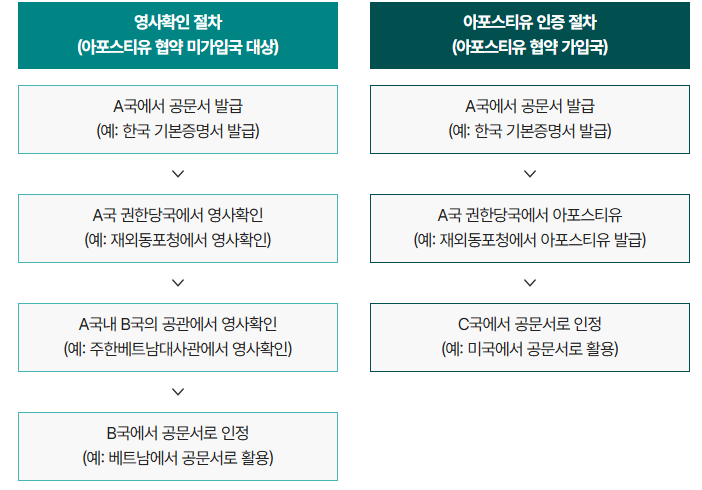
For countries like Vietnam, where the agreement is about to enter into force, the period before and after the enforcement date is the most dangerous.
Cases received before the effective date will go to the old procedure, and cases after that will go to the new procedure. However, since embassy certification takes time from application to issuance, if you apply close to the enforcement date, you may run into a situation where it gets stuck in the middle.
During the transition period, it is safe to schedule with plenty of time, and if it is an ambiguous time, it is safe to first check which procedure to proceed with before starting.
Frequently Asked Questions
Q. Can’t I just follow the procedures I received last year?
Agreement membership status may have changed. It changed in 2023 for China and in September 2026 for Vietnam. It is safe to check the current status before starting your documents.
Q. Isn’t embassy authentication for all Middle East countries?
No. Türkiye, Israel, Morocco, Saudi Arabia, and Qatar are signatories to the convention, so they process with Apostille. UAE, Iraq, Iran, and Egypt are non-members.
Q. Saudi Arabia is a member country, so why does it require additional confirmation?
Because it is a transition period after joining the convention, some organizations may customarily request confirmation in the old way. Confirmation with the submission destination in advance can reduce confusion.
Q. Does Thailand accept Apostille?
Not yet. The registration process is in progress, but has not yet taken effect, so it currently follows the consular authentication process. The fermentation time may change, so check before proceeding.
Q. Where can I check the status of the agreement?
You can check this in the Hague Conference on Private International Law Convention status table or in the information provided by the Office of Overseas Koreans. It is a good idea to check the effective date as well as whether you have signed up.
Conclusion
The member countries of the Apostille Convention keep changing. Judging by region or previous experience may be wrong, and especially if you only received an Apostille thinking it was a member country, but it turned out to be a non-member country, the loss is significant. The best preventive measure is to check the current status of the submission country before starting your documents, as well as the submission destination requirements.
When Nanum Global receives documents, it first checks the current agreement status of the submitting country and establishes procedures. If you are a country in transition, we will guide you through which process to follow depending on the time point. If you are confused about the submission country procedures, please let us know the country, document type, and submission time. We will reply with a summary of the steps to follow.
Are you confused about the status of the submission country’s agreement?
If you tell us the country, document type, and submission time, we will inform you whether it is Apostille or Embassy authentication.


