
2026-11-03
A frequently asked question is: "If I am filing trademark applications in multiple countries, do I need to have a power of attorney notarized for each one?"
It depends on the country. Even if a power of attorney is signed on the same day using the same template, some countries may only require a scanned copy, while others may demand an original document that has undergone notarization and embassy legalization. The Middle East, in particular, often involves an embassy legalization step, making the process quite time-consuming; as a result, the power of attorney requirement can frequently become a bottleneck when rushing to meet filing deadlines.
Let’s break down the power of attorney requirements for major filing jurisdictions into these four categories.
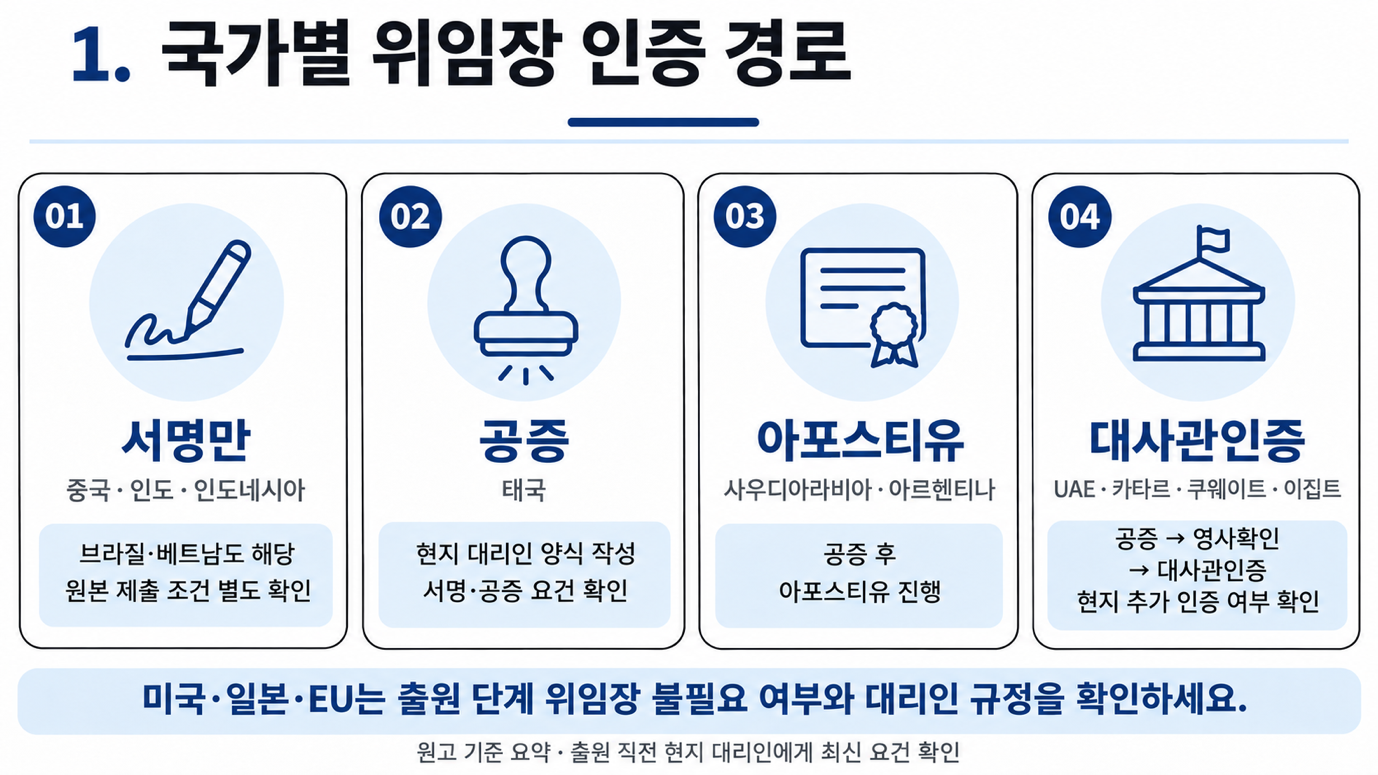
The table below is based on publicly available information and guidance from local agents as of October 2026. Requirements are subject to change; please verify them immediately before filing an application.
| Requirements | Examples of Countries | Procedure in South Korea |
|---|---|---|
| Signature only (no notarization or certification required) | China, India, Indonesia, Brazil, Vietnam | Submit a signed copy (for Vietnam, the original must be submitted subsequently) |
| No Power of Attorney required at the filing stage | United States, Japan, European Union | Check regulations regarding the appointment of a local agent |
| Notarization | Thailand | Notarization |
| Notarization + Apostille | Saudi Arabia, Argentina | Notarization → Apostille |
| Notarization + Consular Legalization + Embassy Certification | UAE, Qatar, Kuwait, Egypt | Notarization → Consular Legalization → Certification by the embassy in South Korea; additional certification by the local Ministry of Foreign Affairs may be required |
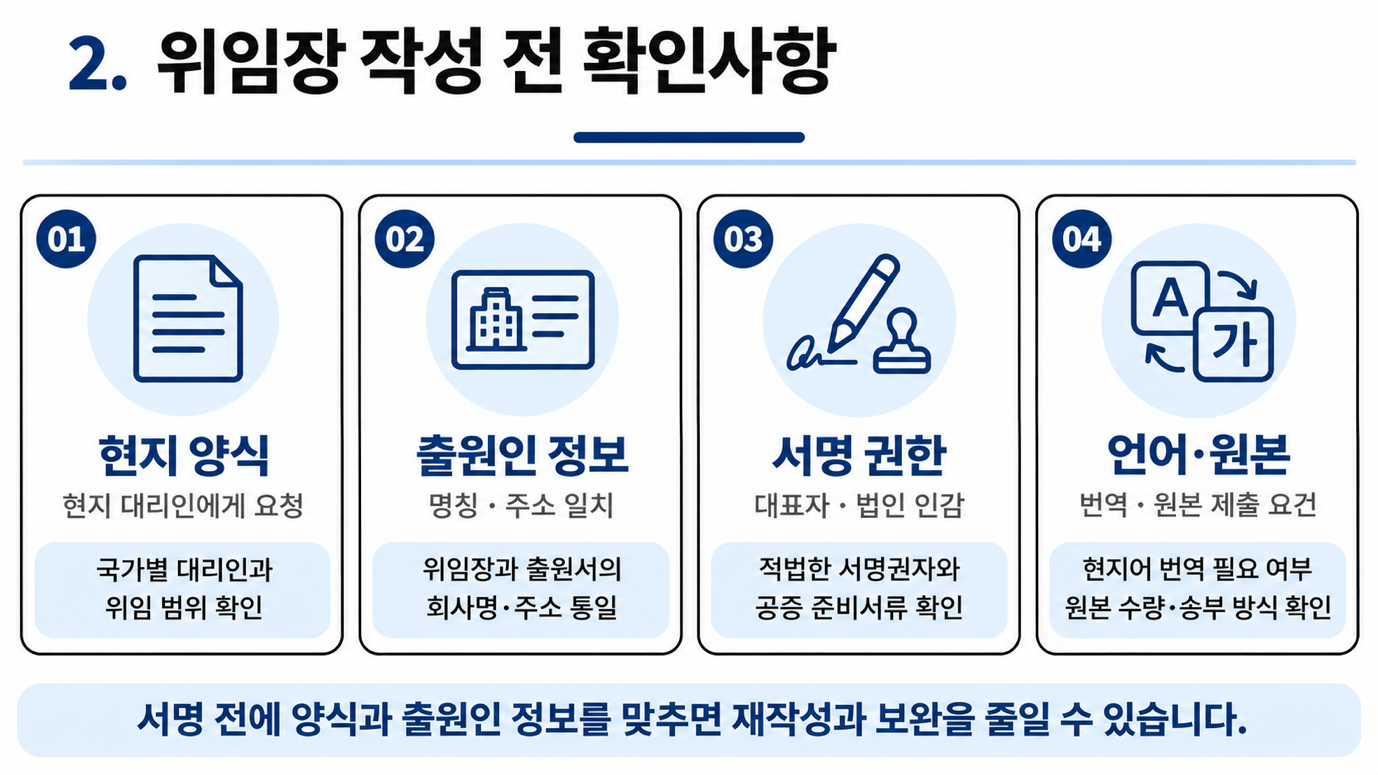
A Power of Attorney is a private document prepared by the company. For countries that require authentication, documents must first be notarized, followed by an Apostille or consular legalization. To ensure the notarization process proceeds without issues, the documents must accurately include the signature of the authorized representative (CEO), the corporate seal, and the precise scope of the power of attorney.
As a general rule, you should use the specific form provided by your local representative. The applicant’s name and address must match those on the application exactly—down to the last character. If the English company name differs from the version recorded in the official corporate registry, you may be asked to provide corrections during the notarization stage or by the local examining authority. Even if the same template is used across multiple countries, each country requires its own version, as the representative’s name and the specific terms of the power of attorney will vary by jurisdiction.
In the UAE, a power of attorney must be notarized and then legalized by both the UAE consulate and the local Ministry of Foreign Affairs. However, it is permissible to submit a letter of undertaking (commitment letter) to initiate the filing, with the requirement to provide the fully legalized document within a specified timeframe; a 2026 administrative decision has also temporarily allowed for the extension of this period. Qatar similarly requires consular legalization and certification by the Qatari Ministry of Foreign Affairs; reports indicate that as of September 2026, applicants may submit a letter of undertaking to allow the examination process to proceed using a power of attorney that has not yet undergone full legalization. Egypt requires a power of attorney legalized by an Egyptian consulate and entails specific requirements regarding the Arabic language; sources vary on the subsequent submission deadline, citing either three or six months.
Since December 2022, Saudi Arabia has been a party to the Apostille Convention, meaning documents can be processed via an Apostille following notarization. Be careful, as many outdated resources still state that consular attestation (legalization) is required for Saudi Arabia.
For China, applications can be filed using scanned copies of signed documents; however, documents verifying the applicant’s identity or business status must be translated into Chinese. In Vietnam, notarization is not required, but the original documents must be submitted within one month of the filing date. In the United States, instead of a power of attorney, foreign applicants are required to appoint a U.S. attorney.
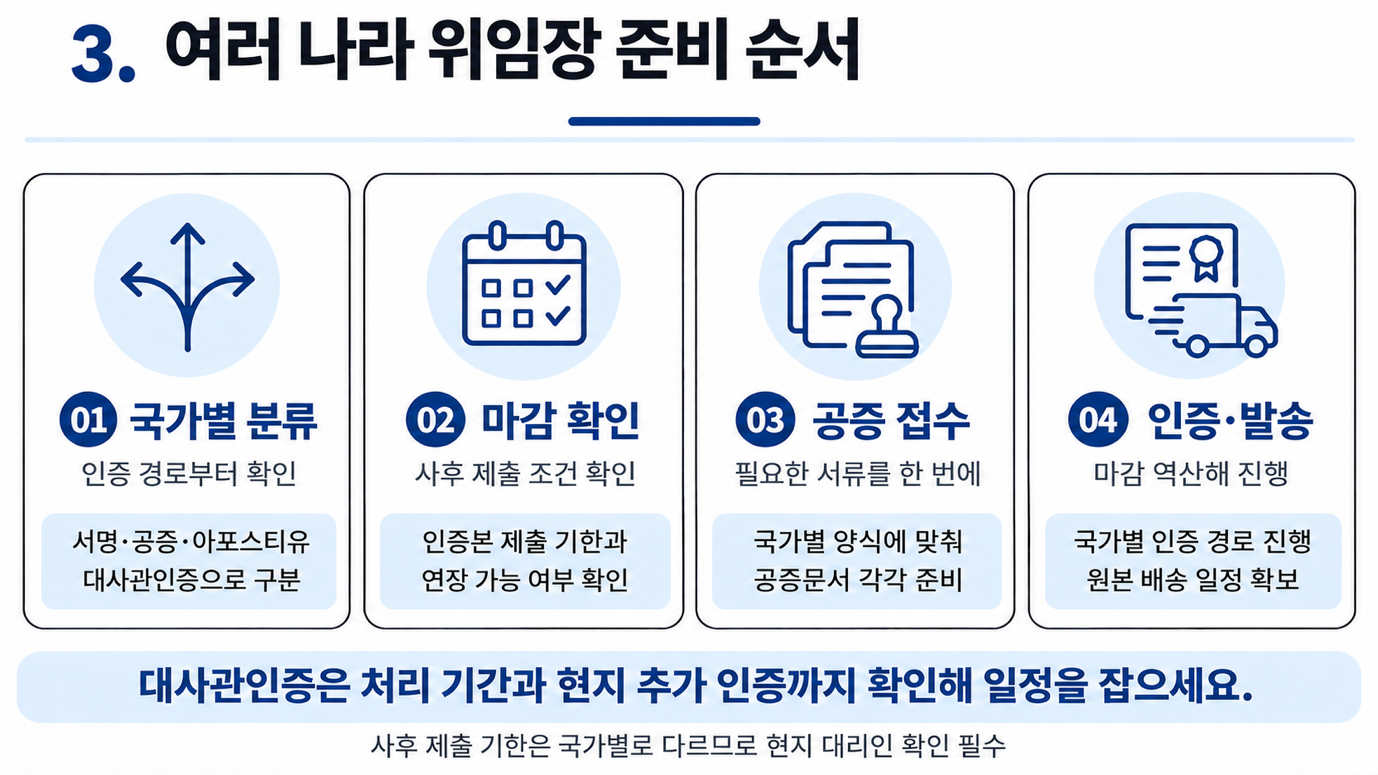
First, categorize your target countries based on the requirements mentioned above. For countries that require attestation, you can submit all the powers of attorney to a notary office on the same day—requesting separate notarized documents for each country—to save time. Next, separate the documents that require an Apostille from those that require consular attestation. Since processing times for consular attestation vary by country, it is best to prioritize the countries with the earliest deadlines. Also, remember that you will need an original power of attorney for each individual country.
As of December 2022, Saudi Arabia is a party to the Apostille Convention; therefore, documents can be processed via an Apostille after notarization. It is recommended to confirm this with your local representative.
Some countries, such as the UAE, Qatar, Egypt, and Vietnam, allow for the submission of these documents at a later stage. Deadlines and requirements vary by country, and some have recently changed.
You can submit them all on the same day. However, you must obtain separate notarized documents for each country, as the subsequent processes—such as Apostille, consular legalization, or embassy attestation—must be handled individually for each destination.
While English-language forms are generally accepted, some countries—such as Egypt—may require the document to be in Arabic. It is safest to use the specific form provided by your local representative.
The first step in preparing a power of attorney for an overseas trademark application is to categorize the target countries based on their specific requirements: simple signature, notarization, Apostille, or embassy attestation. For countries that require embassy attestation (common in the Middle East), be sure to check whether late submission is permitted and what the applicable deadlines are; this will help you stay on track with your application schedule.
Nanum Global can notarize powers of attorney for multiple countries simultaneously and handle the subsequent Apostille, consular legalization, or embassy attestation processes for each country individually. If you provide us with the target countries and your deadlines, we will outline the required authentication procedures and estimated timelines for each.
Let us know the target countries and your deadlines, and we will provide a clear breakdown of the necessary notarization, Apostille, and embassy attestation procedures, along with an estimated timeline for each.


