
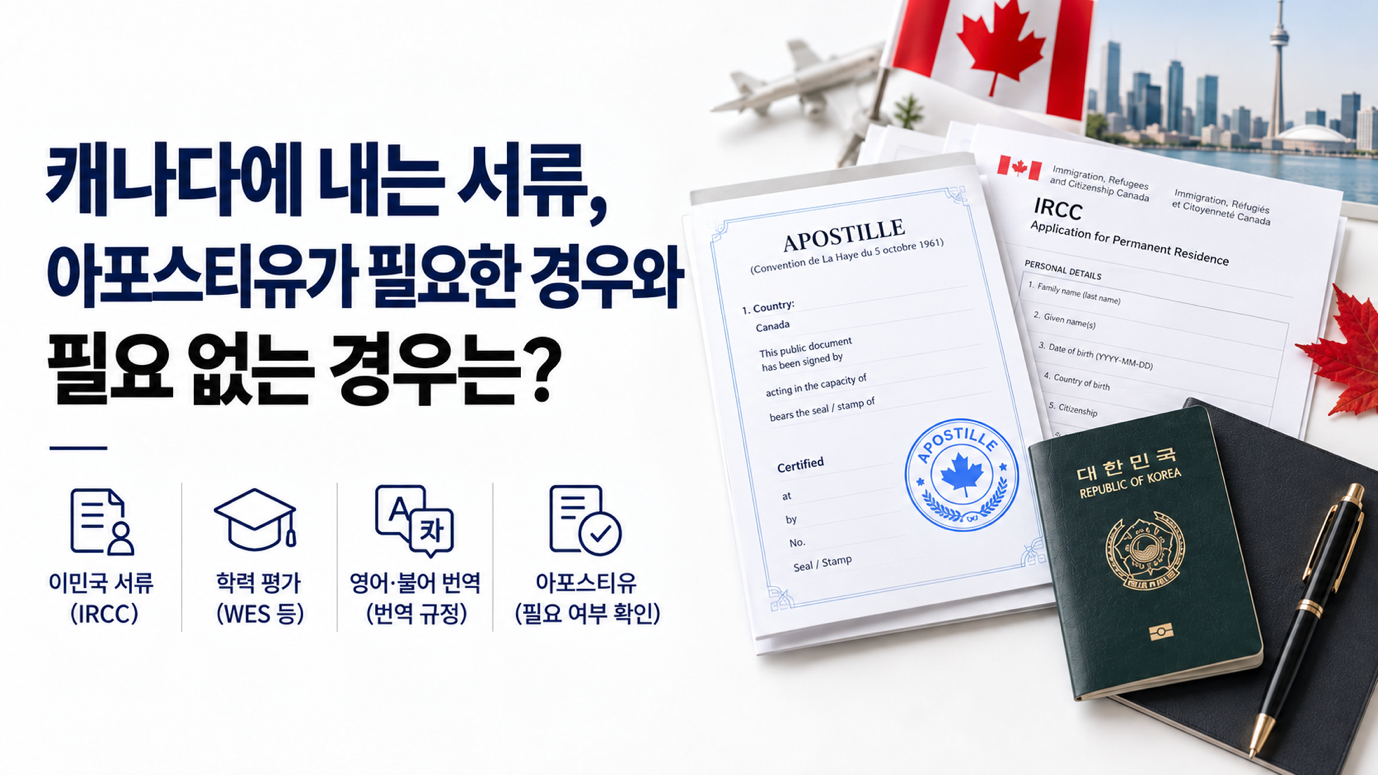
Key Summary
- General RuleWhile Canada is a party to the Apostille Convention, Canadian law does not require prior legalization of foreign public documents.
- IRCCFor visas, working holiday permits, or permanent residency, the requirements for translation into English or French are generally more critical than the Apostille itself.
- ExceptionsIf the receiving institution mandates that only certified documents be submitted, you should obtain an Apostille from the Overseas Koreans Agency.
A common question is: "I am preparing documents for studying in Canada—do I need an Apostille for my Family Relation Certificate?"
In most cases, it is not required. Many people mistakenly prioritize obtaining an Apostille when preparing documents for Canada; however, Canadian institutions are far more concerned with the translation and the authenticity of the original document (or a copy thereof). Conversely, failing to provide an Apostille when it is actually required will lead to delays in your timeline.
In this article, we will outline whether an Apostille is necessary for various Canadian submission requirements and clarify which steps you should prioritize.
Organized by submission destination
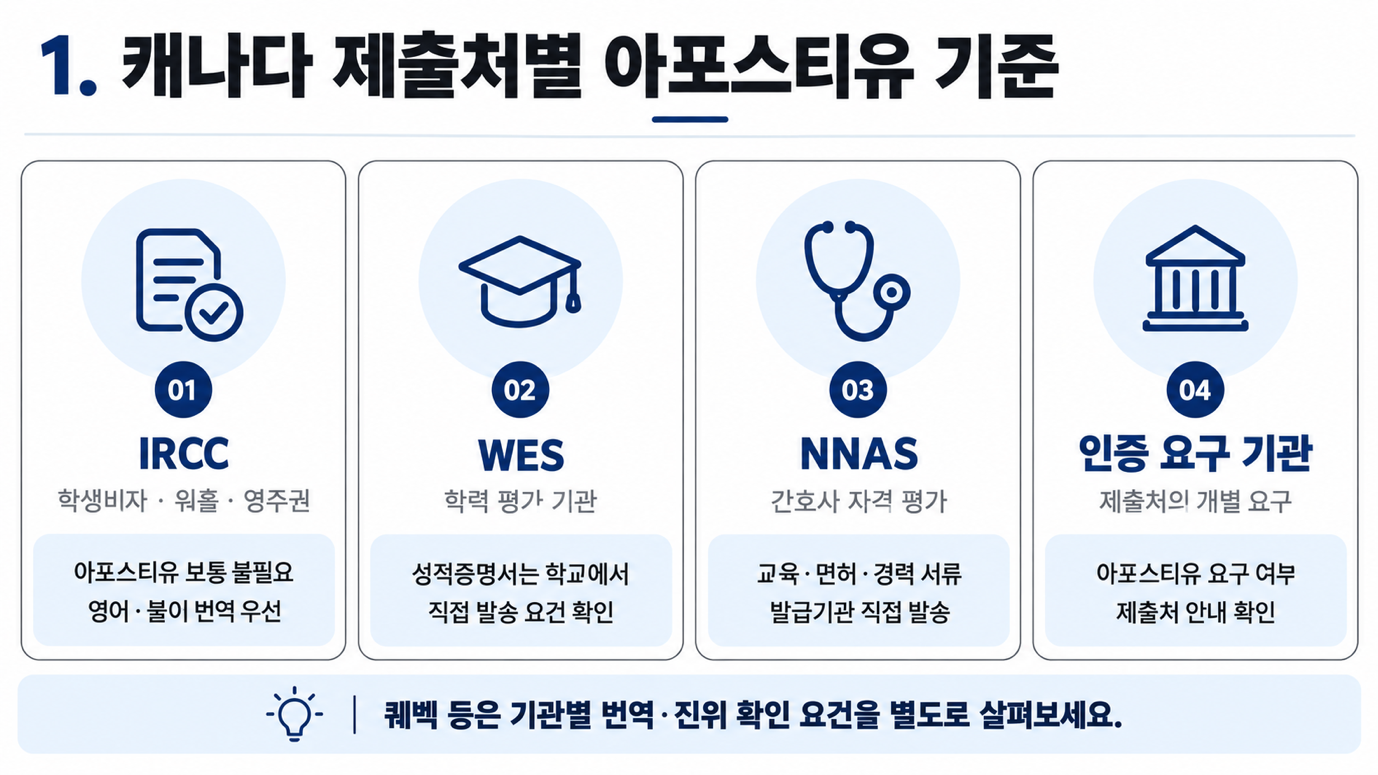
| Submitted to | Apostille | What to take care of first |
|---|---|---|
| IRCC (student visa, working holiday, permanent residency, spouse invitation) | Normally unnecessary | English/French translation regulations, original copy |
| Academic achievement evaluation organizations such as WES | Apostille cannot be used instead of sending directly | Transcripts are sent directly from the school |
| Nurse Qualification Assessment (NNAS) | No required information | Documents sent directly to the institution, designated translation |
| Quebec identity registration (foreign birth/marriage record registration) | No specification required | Request for verification of authenticity, translation by Quebec certified translator |
| Institutions informed that they only accept certified documents | Required | Overseas Koreans Office Apostille |
Canadian law does not require certification
Global Affairs Canada advises that Canadian law does not require authentication prior to the use of foreign official documents. However, he adds, some individuals or institutions may decide to only accept certified or apostilled foreign documents.
In summary, Apostille is not a procedure required by the country called Canada, but is a procedure required only when requested by the institution receiving the document. So, the starting point is to first check the instructions from the submission destination.
IRCC documents must be translated first
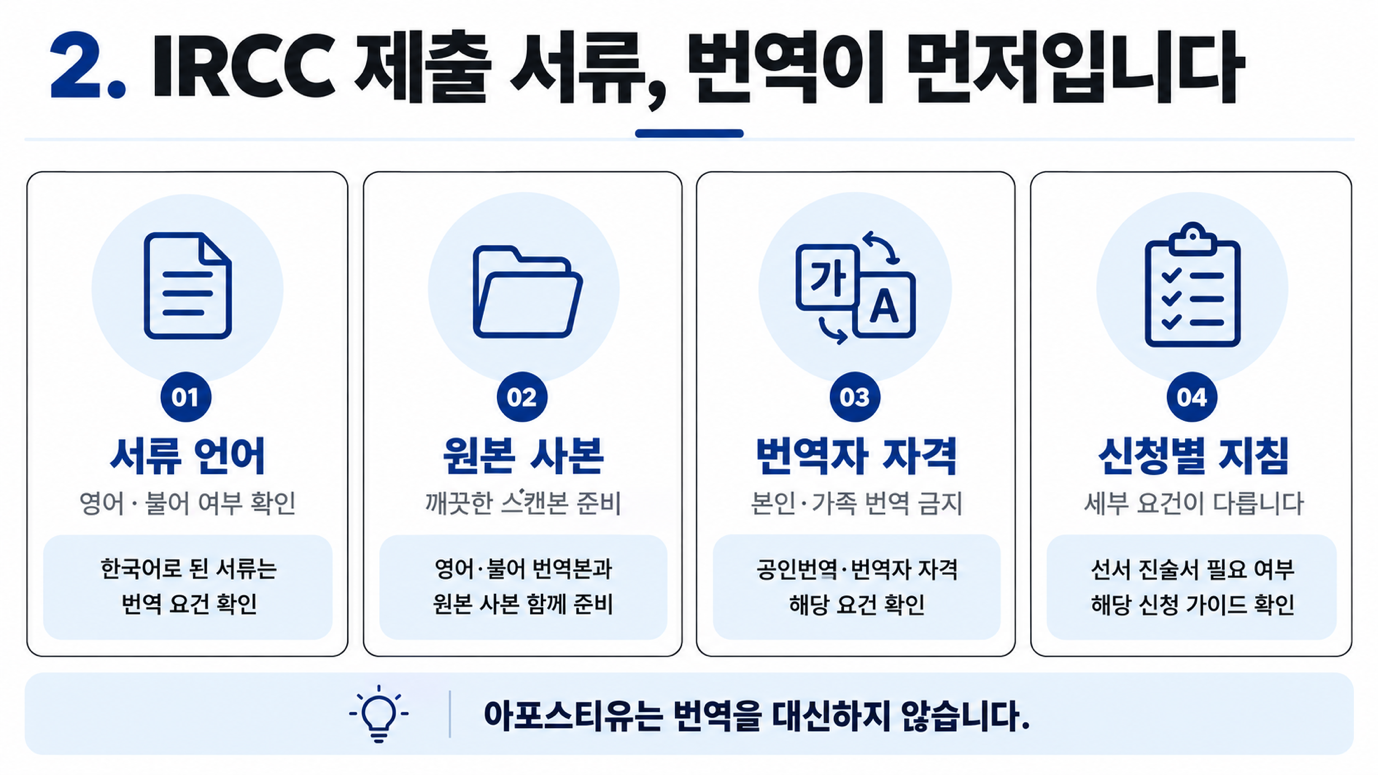
The Immigration Service's general application instructions do not require Korean documents to be apostilled. Instead, documents that are not in English or French must be accompanied by a translation and a copy of the original, and the applicant or his/her family cannot translate. Translator qualifications and affidavit requirements are also set, so these parts are often missed and requests for supplementation are made.
Translation regulations vary slightly depending on the type of application. In the Spouse Invitation Guide, if the translation is made by someone other than a Canadian certified translator, the translator must attach an affidavit sworn in front of a notary public, and the Express Entry guide has a clause that recognizes translations by members of overseas translation associations. This is why you must prepare different translation formats for the same Canadian documents depending on which application you are submitting.
Since you are instructed to send the original only when requested, it is more efficient to spend effort preparing clean scans and accurate translations instead of the original.
In principle, academic background and qualification evaluations are sent directly from the institution.
WES, an academic evaluation agency frequently used in Canadian immigration, advises that transcripts must be received directly from school electronically or in a sealed envelope. Even if you send an Apostille transcript, it cannot be replaced. A copy and translation of the degree certificate must be uploaded by the applicant.
Nurse Qualification Assessment (NNAS) also requires each organization to send education, licensing, and experience documents directly. In these places, the schedule is more determined by sending requests to schools and organizations on time than by Apostille.
When you need an Apostille, it's just one step
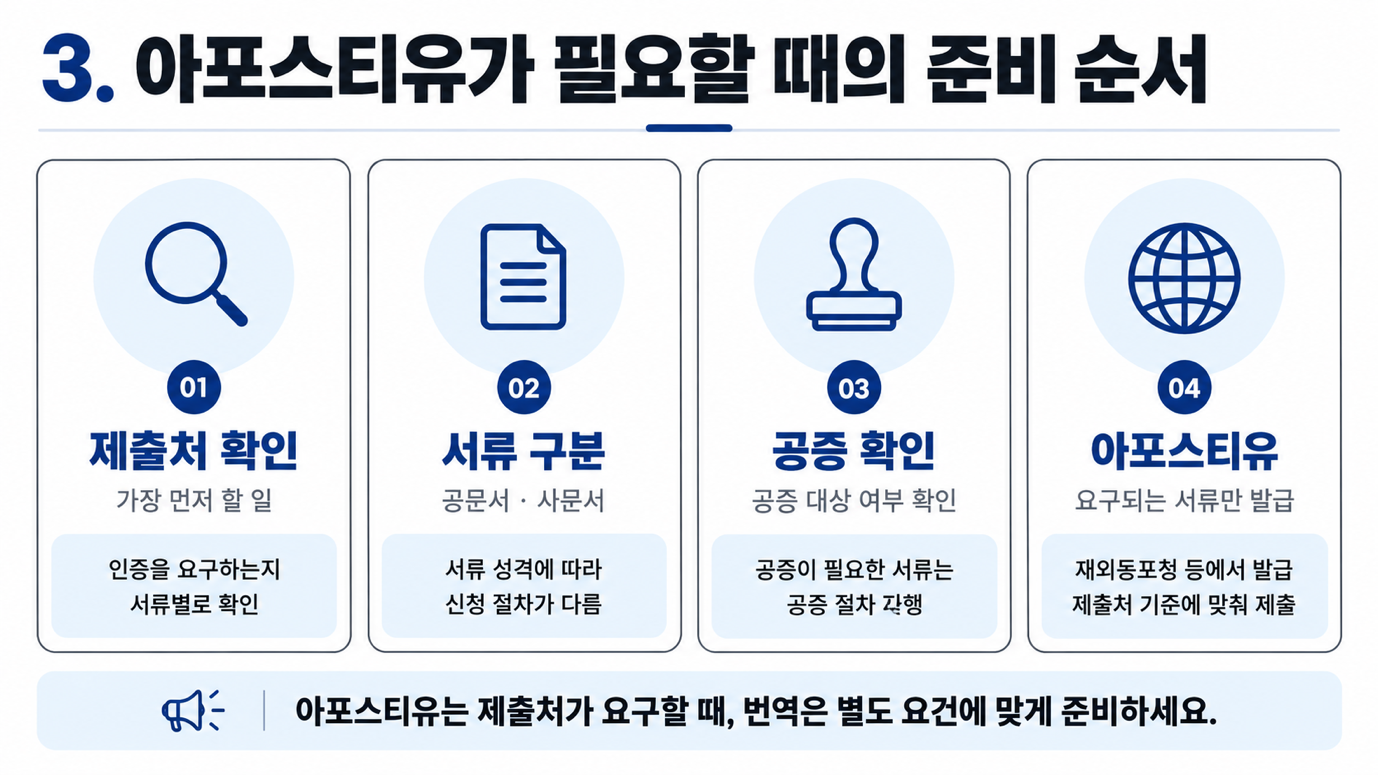
If the submission site requires authentication, since Canada is a convention country, it ends with an Apostille without going through an embassy. Official documents such as family relationship certificates receive an Apostille directly from the Overseas Koreans Office, while private documents such as company documents receive an Apostille after notarization. If you need to certify the translation, notarize both the translation and the original (or a copy of the original) and then receive an Apostille on the notarized document.
It is recommended that family relations documents be issued as detailed certificates from the beginning. Canadian agencies often expect documents showing all birth, marriage, and divorce history, so it often happens that they prepare a general certificate, then reissue it, and even have to translate it.
Frequently Asked Questions
Q. Is an Apostille required for the family relationship certificate submitted for a Canadian student visa?
Immigration authorities usually do not require it. Instead, you must follow the English or French translation rules.
Q. How do I submit documents for admission to Canadian universities?
It varies from school to school. Many places ask you to send your transcript directly from the school, so check the information from the admissions office first.
Q. If I receive an Apostille, do I not have to translate it?
No. Apostille only confirms the authenticity of the document, and Korean documents require separate translation into English or French.
Q. What should I do if the submission party requests legalization?
Canada is a convention country, so Apostille plays that role. There is no need to obtain embassy authentication.
Conclusion
For Canadian documents, it is better to check the translation regulations and requirements for sending directly to the institution rather than whether an Apostille is required. Authentication only needs to be processed with a one-step Apostille when requested by the submission site.
Nanum Global provides English translation of documents submitted to Canada, notarization of translation, and even Apostille if necessary. If you let us know where to submit and the list of documents, we will guide you through which documents require an Apostille and which only require translation.
Do you need Canadian submission documents?
If you let us know where to submit and the list of documents, we will guide you through which documents require Apostille and which only require translation.


