
Key Summary
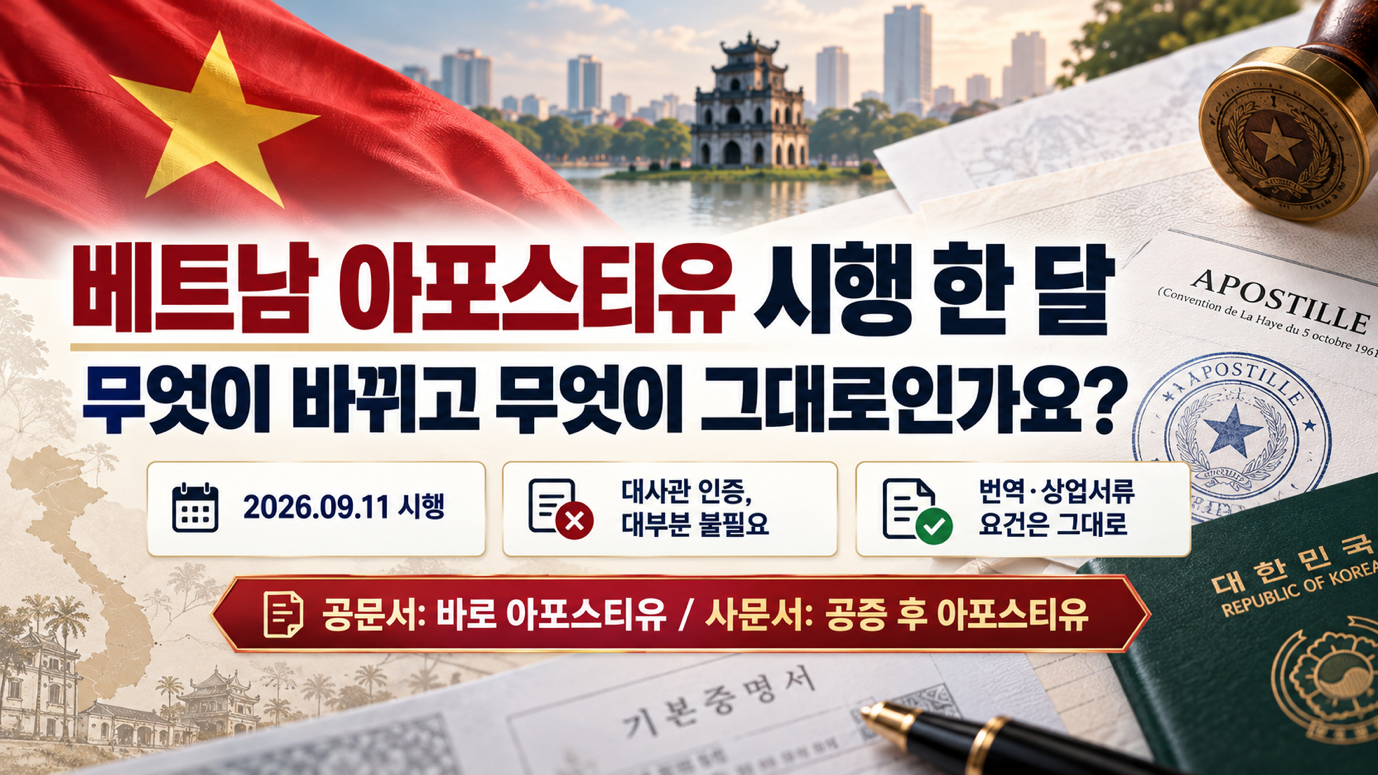
- ChangeStarting September 11, 2026, Korean documents can be submitted to Vietnam with one step of Apostille.
- Official documentApostille immediately / Apostille for private documents after notarization
- MaintenanceThe requirements for Vietnamese translation/translation certification, consular certification for commercial/customs documents, and issuance date remain the same.
There are frequently asked questions. “Now that Vietnam has Apostille, I don’t have to go to the embassy, right?”
Most of it is correct. Almost a month after implementation, the parts that have changed have clearly changed, and the parts that have clearly remained the same. In particular, there are many cases where people think, “All I need is an Apostille and that’s it,” but then ask again during the translation stage.
Let's point out the changes confirmed one month after implementation and the areas that still need to be taken care of, along with a table.
Changes at a glance
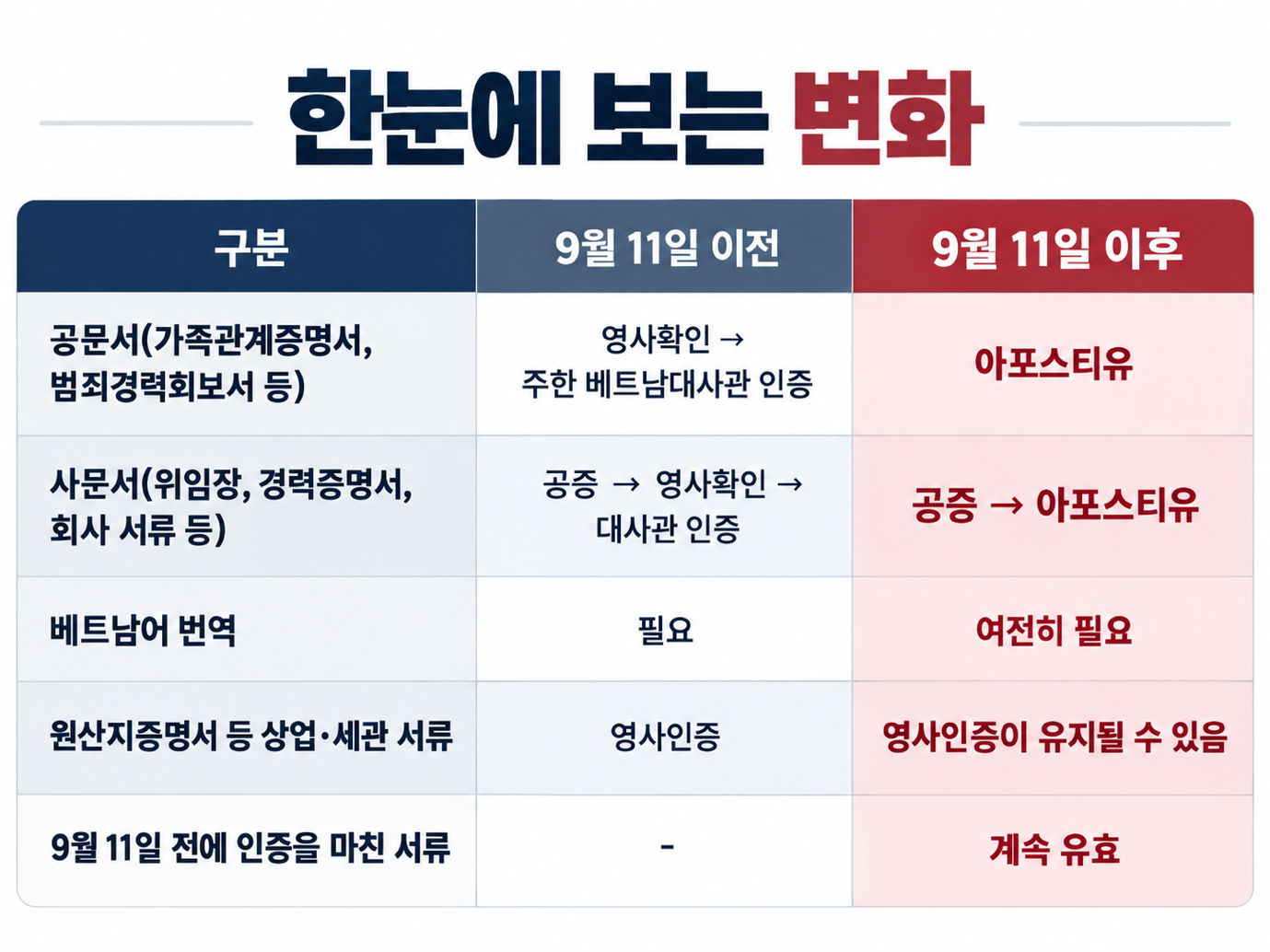
| Classification | Before September 11th | After September 11th |
|---|---|---|
| Official document | Consular authentication → Vietnamese Embassy in Korea authentication | Apostille |
| Private document | Notarization → Consulate confirmation → Embassy authentication | Notarization → Apostille |
| Vietnamese translation | Required | Still needed |
| Commercial/customs documents | Consular Authentication | Consular certification can be maintained |
| Previous certification documents | - | Still valid |
Changed: Embassy step is missing
The biggest change is the disappearance of the Vietnamese Embassy in Korea certification. In the past, there were three steps: get it notarized, get consular authentication, and then submit it to the embassy again and wait for authentication. Currently, it is a two-step process that ends with notarization and receiving an Apostille. For documents that are official from the beginning, such as a family relationship certificate, all you need is an Apostille without notarization.
Vietnamese basis regulations have also been established. Official documents from countries that have received an Apostille are exempt from consular authentication, and Vietnamese institutions cannot request additional authentication. The basis is Article 25 of Vietnam Enforcement Decree 293/2026, promulgated in line with the implementation of the Convention.
By eliminating embassy reception and waiting, the schedule was shortened by a few days, and the overall cost was lowered by the embassy fee and agency costs at that stage.
Same thing 1: Vietnamese translation
This is where you are most confused. Apostille only confirms that the document is an official document and does not convert the content into Vietnamese. Article 27 of the same enforcement decree stipulates that when submitting a foreign document to a Vietnamese institution, a Vietnamese translation must be attached, and the translation must be notarized or certified in accordance with Vietnamese law.
In practice, two methods are used. One way is to translate documents that have been apostilled in Korea in Vietnam and have the translation certified locally. The other method is to translate from Korea to Vietnamese, notarize both the translation and the original (or a copy of the original), and then receive an Apostille on the notarized document.
Which one is accepted may vary depending on the submitting institution, so it is best to check with your local representative before starting the documents.
What remains the same 2: Commercial and customs documents
From the beginning, the Apostille Convention excluded administrative documents directly related to commerce or customs work from its application. Therefore, documents such as certificates of origin can still be requested for consular authentication and embassy authentication even after Vietnam becomes a contracting country. The Vietnamese Embassy in the United States also provided separate guidance on this part in its implementation notice. If you are a company that handles import and export documents, you must manage documents that have been apostilled and those that have not been apostilled.
What remains the same 3: Previous certification and issuance date requirements
Documents that have been confirmed by the consulate and certified by the embassy before September 11th are still valid and do not need to be apostilled again. However, the validity period of the document itself is separate. For example, the criminal record certificate submitted for a Vietnam work permit must have been issued within 6 months from the date of submission.
Additionally, Germany, Austria, and the Czech Republic objected to Vietnam's accession, so Apostille does not apply between these three countries and Vietnam. Since Korea has not raised any objection, Korean documents can be submitted with Apostille. Some local offices are not yet familiar with Apostille documents, so if you have a tight schedule, it is safer to start early.
Frequently Asked Questions
Q. Can I submit documents that were certified by the embassy before September now?
Yes. Consular authentication and embassy authentication received before the effective date will remain valid. You only need to check the issuance date requirements of the document itself based on the submission destination.
Q. If I receive an Apostille, do I not have to translate it into Vietnamese?
No. Foreign documents submitted to Vietnamese institutions still require Vietnamese translation, and the translation must be notarized or certified in accordance with Vietnamese law.
Q. Has the certificate of origin also been changed to Apostille?
Documents directly related to commercial and customs duties are not subject to the convention, so existing consular authentication can be maintained. It is safer to check with the submission destination first.
Q. Where do I get an Apostille?
In June 2023, the work of the Ministry of Foreign Affairs will be transferred to the Office of Overseas Koreans, and it is now issued by the Office of Overseas Koreans. There are also official documents that can be obtained online, such as a criminal record report.
Conclusion
With the implementation of Vietnam Apostille, the schedule and cost were reduced by eliminating the embassy step. On the other hand, the Vietnamese translation and certification, consular certification of commercial and customs documents, and issuance date requirements for each document remained the same. Even if you distinguish these three things in advance, you can greatly reduce the likelihood of rejection.
Since its implementation, Nanum Global has been processing Vietnamese documents based on the Apostille standard, and provides translation, notarization, and Apostille all at once. If you are confused about whether the document you are sending ends with an Apostille or whether it still requires consular authentication, please let me know the list of documents and where to submit them. We will reply with a summary of the necessary steps.
Are you confused about the documents to submit in Vietnam?
If you tell us the list of documents and where to submit them, we will guide you through Apostille or consular authentication and how to translate them.


