

Key Summary
- Effective dateFrom September 11, 2026, Vietnam will become a party to the Apostille Convention.
- Things that changeThe Vietnamese Embassy in Korea authentication step that has been required has been eliminated, and document authentication is completed with a single Apostille from the Ministry of Foreign Affairs.
- CautionDocuments received before and after the effective date have different processing standards. Beware of confusion during the transition period.
- The same thingEven though the procedures have been reduced, translation and notarization are still required.
There are frequently asked questions. “Is it true that sending documents to Vietnam will change from September?”
It's true. From September 11, 2026, Vietnam will become a party to the Apostille Convention. What this means is that the embassy authentication step that had to be completed until now when sending documents to Vietnam will be eliminated, and it will be completed with a single Apostille from the Ministry of Foreign Affairs. This means the process is reduced by one step.
If you are a business doing business with Vietnam, especially if you frequently process incorporation, investment, labor documentation, or import/export documentation, this change will have an immediate impact on your practice. In this article, we will outline what exactly is changing, how to handle documents in progress before and after the effective date, and why you should not let your guard down just because the procedures have been reduced.
What disappears and what remains
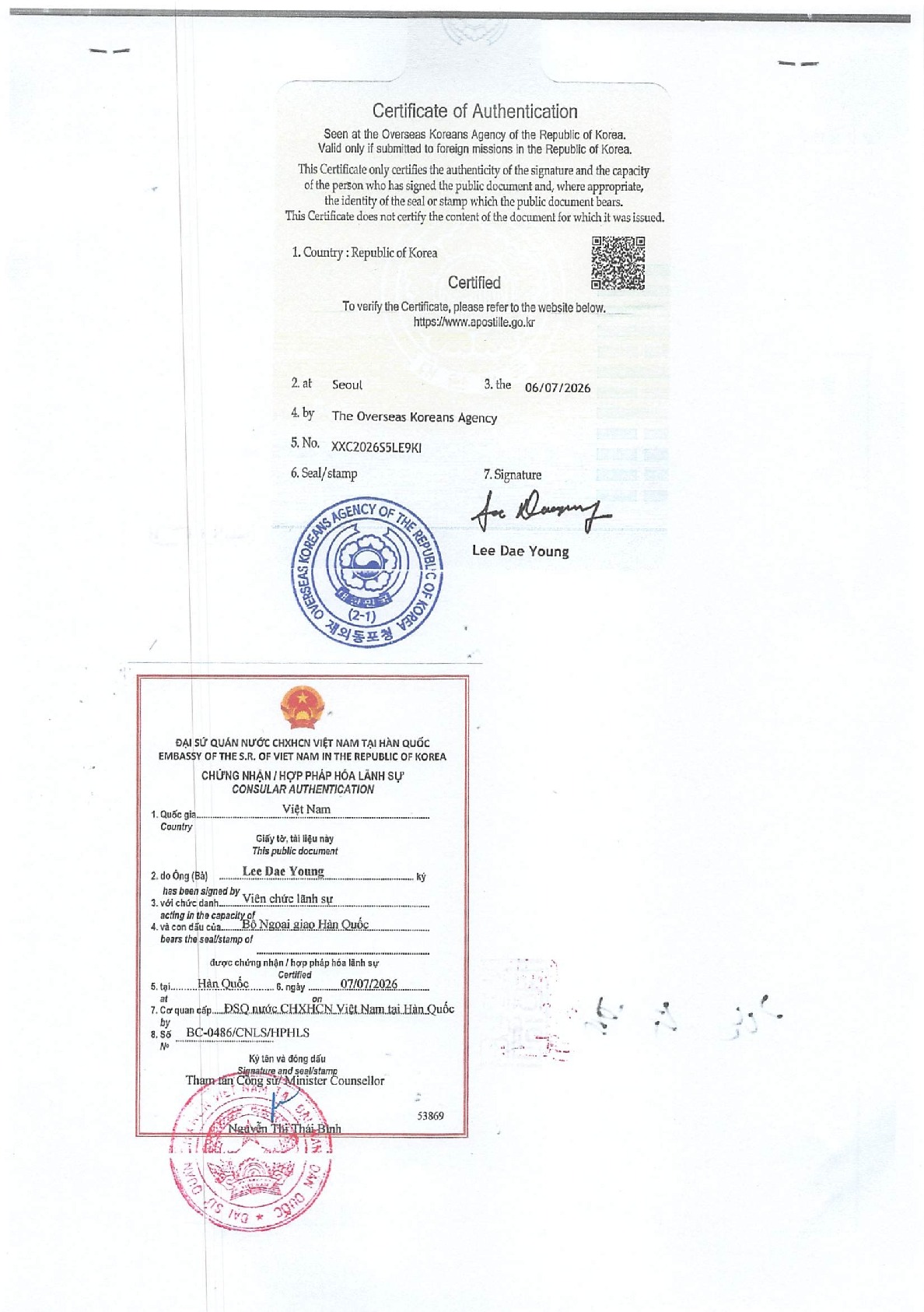
The process for sending documents to Vietnam now involves three steps. After translation and notarization, it receives consular authentication from the Ministry of Foreign Affairs and finally authentication from the Vietnamese Embassy in Korea. This final embassy verification step will disappear from September 11th.
From now on, you only need to receive an Apostille from the Ministry of Foreign Affairs after translation and notarization. There is no need to visit the embassy separately or wait for the embassy application. Submission of documents issued in Vietnam to Korea is similarly simplified. You can think of it as applying in both directions.
This is the same path that China took before. In China, as the Apostille Convention came into effect in November 2023, the consular authentication process at the Chinese Embassy in Korea was abolished. Vietnam is now following suit.
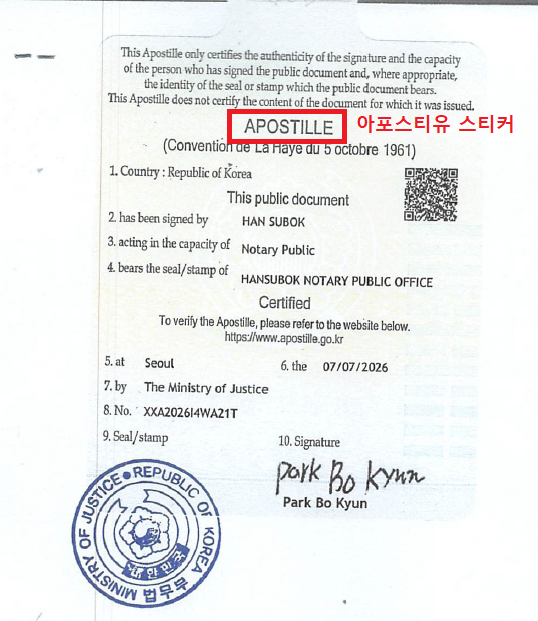
If you become an Apostille Convention country, only Apostille stickers will be issued as shown in the photo below.
What happens to documents in progress before and after the enforcement date?
This is the most confusing part. Because the procedures change based on the enforcement date of September 11, judgment may become ambiguous for documents received around that time.
The principle is this. Cases received before the effective date must go through the existing procedures, namely consular authentication and embassy authentication. Cases received after the effective date will be processed with one Apostille step. The problem is that embassy certification is a time-consuming process, so if you apply close to the enforcement date, there may be a delay.
If you have documents currently in progress or scheduled to be submitted in late August or early September, it is safe to schedule your time. If it is an ambiguous time, it is better to check in advance which procedure is correct before starting to reduce trial and error.
Why you should not let down your guard even if procedures are reduced
There is something easy to misunderstand here. Now that embassy authentication is gone, it is easy to think that all you need is an Apostille and there will be no problem, but that is not the case.
The procedure has been reduced by one step, but the previous steps of translation and notarization remain the same. Rather, this is where complaints often arise. There are cases where the translation is inaccurate, the document requirements are not properly met, or documents that require notarization are omitted and the documents are rejected locally.
In particular, corporate documents have more stringent requirements than personal documents. Contracts, power of attorney, and corporate documents must be translated and formatted accurately to be accepted locally. If you neglect this part just because the procedure has been simplified, the time equivalent to the reduced steps will be wasted in rejection and reprocessing.
If you are a company with a lot of transactions in Vietnam, check now
If you are a company that repeatedly sends documents to Vietnam, it would be a good idea to use this transition as an opportunity to check a few things.
First, prepare a list of documents scheduled to be submitted after September. Confusion will be reduced if you distinguish between cases that benefit from being handled before the enforcement date and those that can be postponed until later. Also, in Vietnam, there is a renewal cycle depending on the type of document. For example, documents such as a sales authorization letter may need to be updated at certain intervals according to local law, so it is a good idea to check whether any documents are due for renewal.
Frequently Asked Questions
Q. From September 11th, will Vietnam only need to receive an Apostille?
Yes. Documents received after the enforcement date will be processed with a one-step Apostille from the Ministry of Foreign Affairs without embassy authentication. However, cases received before the effective date must go through the existing procedures of consular authentication and embassy authentication.
Q. What happens to the Vietnam documents currently in progress?
Decisions are made based on the time of submission. If it is received before the effective date, it will proceed with the existing procedures. The procedures may become ambiguous for documents that are close to the implementation date, so it is recommended that you schedule with enough time and check in advance which procedure will take place.
Q. Since the procedures have been reduced, can’t I just handle it myself?
The embassy authentication step has been eliminated, but translation, notarization, and review of document requirements are still required. Companions often arise in this area. In particular, corporate documents have strict requirements, so if they are not verified for accuracy, they may be rejected locally.
Q. Does the document received in Vietnam change when submitted to Korea?
Yes. Simplifies both directions. Even when submitting Vietnamese-issued documents to Korea, they are processed with Apostille.
Q. Has the status of joining the agreement been confirmed?
Vietnam's accession to the Apostille Convention and its entry into force schedule have been officially confirmed. However, since the detailed operation of the agreement may change, it is safe to check the latest standards before processing important documents.
Conclusion
The conversion to Vietnam Apostille is a welcome change that reduces procedures, but confusion can easily arise during the conversion period. This is because the processing standards for documents received before and after the enforcement date are different, and neglecting translation and notarization just because the procedures have been reduced can lead to rejection.
Nanum Global handles the entire process from translation of Vietnamese documents to notarization and Ministry of Foreign Affairs certification. We will provide guidance on which procedures to follow for documents in progress during the transition period and what is advantageous for processing before the effective date. If you are concerned about Vietnam transaction documents, please let us know what is in progress and what is planned. If your company needs to handle multiple cases repeatedly, we can provide dedicated response and help you figure out how to proceed.
Vietnamese and overseas document authentication, leave it to Nanum Global
Please let us know the country of submission, document type, quantity, and desired completion date, and we will guide you through the procedures and schedule.


