

Key Summary
- Classification criteriaThe only criterion is whether the country where documents will be submitted has joined the Apostille Convention.
- Member StatesCompletes with one Apostille issuance.
- Non-member countriesIn addition to consular authentication from the Ministry of Foreign Affairs, you must also receive authentication from the embassy of the relevant country.
- CautionIt is easy to get confused as the stickers are similar in shape, and the status of membership in the agreement changes frequently, so you must check the latest standards at the time of submission.
There are frequently asked questions. “Do we need to get our documents Apostille or consular authentication?”
The reason this question is asked so many times is because although they seem similar, they are completely different procedures. The stickers have similar shapes and are both received from the Ministry of Foreign Affairs. Some documents require only an Apostille, while others require consular authentication and embassy authentication. If you judge this incorrectly, your documents may be rejected locally or, conversely, you may waste time and money by going through unnecessary procedures.
In this article, I will explain exactly how Apostille and Consular Confirmation differ, the criteria for determining which category my document falls under, and points of confusion. This will be helpful if you need to send documents overseas but don't know which procedure to follow.
The first thing to check is whether the submitting country has joined the convention.
There is only one standard that differentiates Apostille and consular authentication. The question is whether the country where documents will be submitted has joined the Apostille Convention.
The Apostille Convention is an international agreement signed in The Hague in 1961, and member countries recognize the official validity of a document with an Apostille. There is no need to go through the embassy. Currently, over 120 countries have joined, including the United States, Japan, China, Russia, most European countries, and Australia.
Conversely, when sending documents to countries that have not joined the convention, you must follow the old method. You will receive consular authentication from the Ministry of Foreign Affairs, and on top of that, you will receive further authentication from the relevant country's embassy in Korea. This is called embassy authentication. This includes some countries in the Middle East, such as the UAE, Iraq, and Iran.
To summarize, if the submission country is a signatory to the convention, it is an Apostille, and if it is not a signatory country, it is consular authentication and embassy authentication. This distinction is the starting point.
How different are the procedures?
When you look at the difference in steps between the two procedures, you can understand why you need to know this exactly.
| Classification | Apostille (Convention signatory countries) | Consulate confirmation + Embassy authentication (non-member country) |
|---|---|---|
| Procedure | Document preparation, translation, notarization (if necessary) → Ministry of Foreign Affairs Apostille → End | Document preparation, translation, notarization → Ministry of Foreign Affairs consular authentication → Embassy authentication in Korea |
| Steps required | Step 1 (No need to visit the embassy) | Step 2 (Embassy visit required) |
| Variables | Relatively simple | Each embassy has different application requirements and processing methods, resulting in rejections and delays. |
One more step means there is more to prepare and more variables. This is why documents from non-member countries take longer to process and cost more.
Easy to get confused, stickers look the same
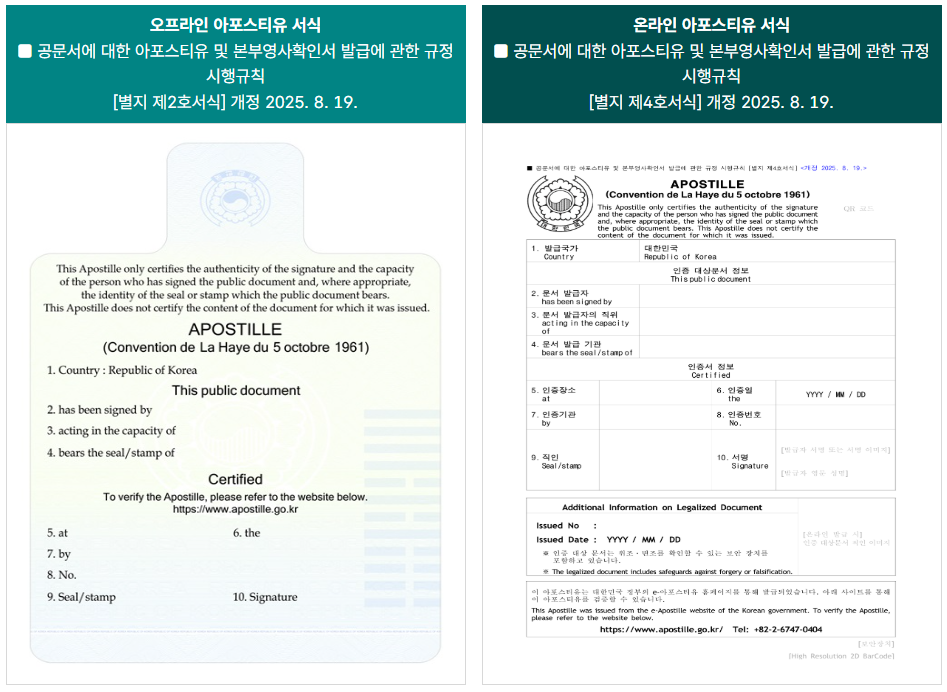
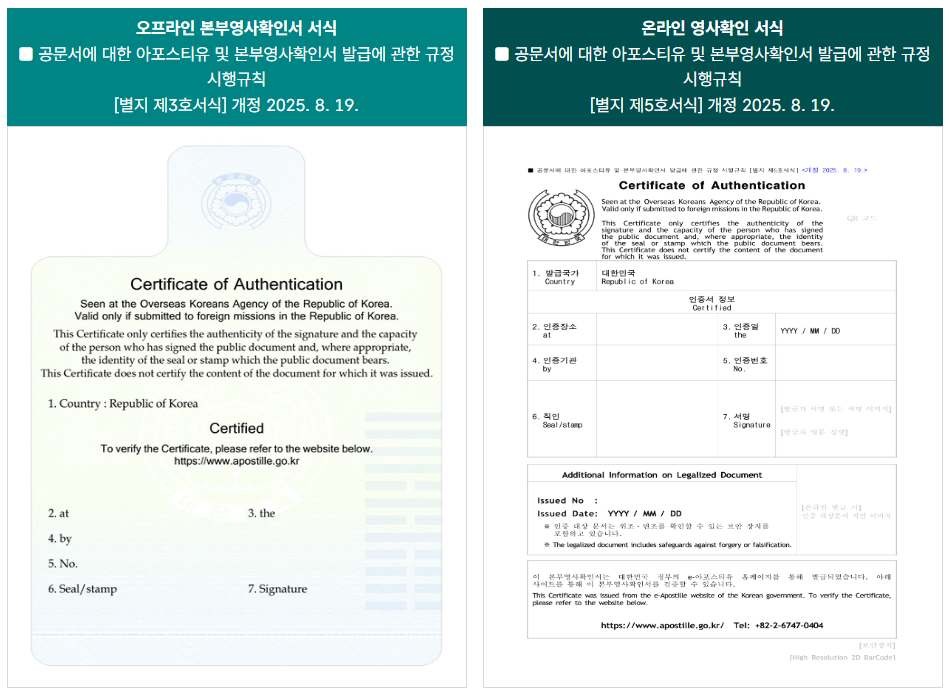
Misunderstandings often arise here. The consular authentication sticker is almost the same as the Apostille sticker. Since it is issued by the Ministry of Foreign Affairs and has a similar appearance, some people mistakenly believe that they have received an Apostille upon receiving the consular authentication sticker.
However, what is written on the sticker is different. One is marked as Apostille, and the other is marked as Consular Confirmation. And consular verification is not an end in itself, but presupposes the next step of embassy verification. If you only receive consular authentication and omit embassy authentication, your documents will not be recognized in non-member countries.
Another thing to note is that agreement membership status is not fixed. China will join the agreement in 2023 and Vietnam in September 2026. Countries that required embassy authentication until last year may change to Apostille this year. So, if you judge the procedure based only on past experience, you may be wrong. If it is an important document, it is safe to check the latest standards at the time of submission.
One more thing if you need translation
When documents must be translated and submitted, there are parts that are often missed in practice. If you only have the translation notarized and certified, it may not be recognized locally.
In principle, Apostille or consular authentication is a procedure to confirm the authenticity of the original document. Therefore, when submitting a translation, authentication is often required for both the original and the notarized translation. If you only receive certification on a notarized translated document, there is a possibility that the receiving organization will not accept it because it cannot verify the authenticity of the original. This part varies depending on the submission destination requirements, so it is best to check in advance.
Frequently Asked Questions
Q. What is the difference between Apostille and consular authentication?
If the submitting country is a signatory to the Apostille Convention, the document is recognized with a single Apostille. If you are a non-member country, you must receive consular authentication from the Ministry of Foreign Affairs and then obtain authentication from the embassy of that country. There is one more step in the non-registration process.
Q. How do I know which side my document is on?
All you have to do is check whether the country where you will submit your documents has joined the Apostille Convention. If it is a member country, it is an Apostille. If it is a non-member country, it is consulate confirmation and embassy authentication. You can check your membership status at the Overseas Koreans Office or the HCCH official website.
Q. I received a consular authentication sticker, isn’t it an Apostille?
The sticker shape is similar, but the notation is different. Consular authentication is a process that presupposes embassy authentication, so if you only receive consular authentication and omit embassy authentication, your documents will not be recognized in non-registered countries.
Q. I received embassy certification last year. Is it the same this year?
Agreement membership status changes. China joined in 2023 and Vietnam joined in September 2026. Since countries that previously received embassy certification may change to Apostille, it is safe to check the latest standards at the time of submission.
Q. How do I authenticate translated documents?
When submitting a translation, authentication is often required for both the original and the translated notarized document. If you only authenticate the translated and notarized document, it may be rejected because the authenticity of the original cannot be confirmed locally. We recommend that you check the submission requirements in advance.
Conclusion
Apostille and consular verification have similar names and stickers, but are completely different procedures depending on whether the submitting country has joined the convention. Accurately determining this is the first step in document authentication. This is because incorrect judgment can lead to local rejection or unnecessary procedures.
Nanum Global helps you determine which process your documents should be processed through. Just tell us the country of submission and the type of document, and we will check whether it is an Apostille or consular authentication, and proceed with translation, notarization, and authentication according to the requirements of the country of submission. If you are not sure which procedure to follow, please let us know the country and documents to be submitted. We will guide you through the procedures and preparation materials.
Vietnamese and overseas document authentication, leave it to Nanum Global
Please let us know the country of submission, document type, quantity, and desired completion date, and we will guide you through the procedures and schedule.


