
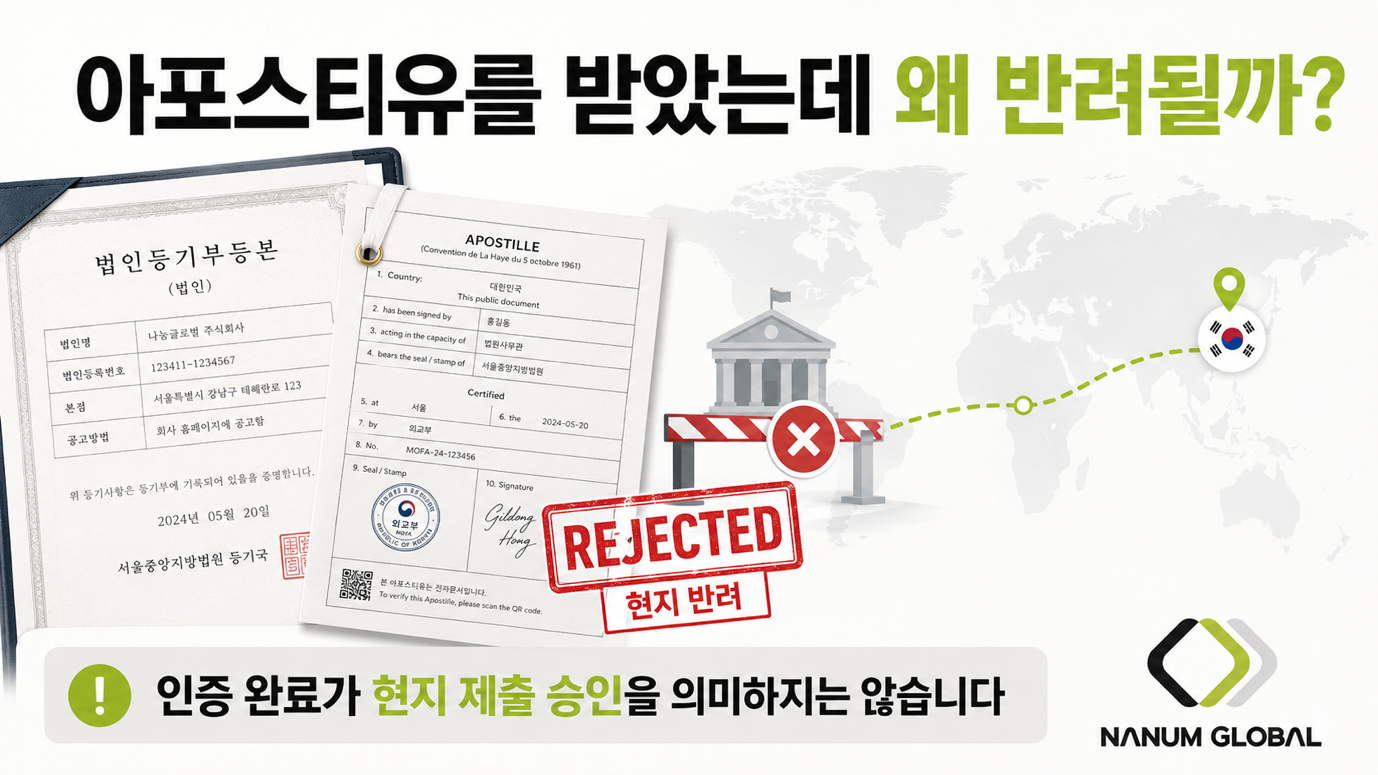
Key Summary
- RangeApostille is only a process to confirm the authenticity of the original document, and does not guarantee that the submission destination requirements are met.
- Cause of rejectionRepresentative examples include translation discrepancies, issuance date lapses, document format discrepancies, and misjudgment of convention membership.
- PreventionBefore certification, it is important to first check the submission requirements (document, format, translation certification target).
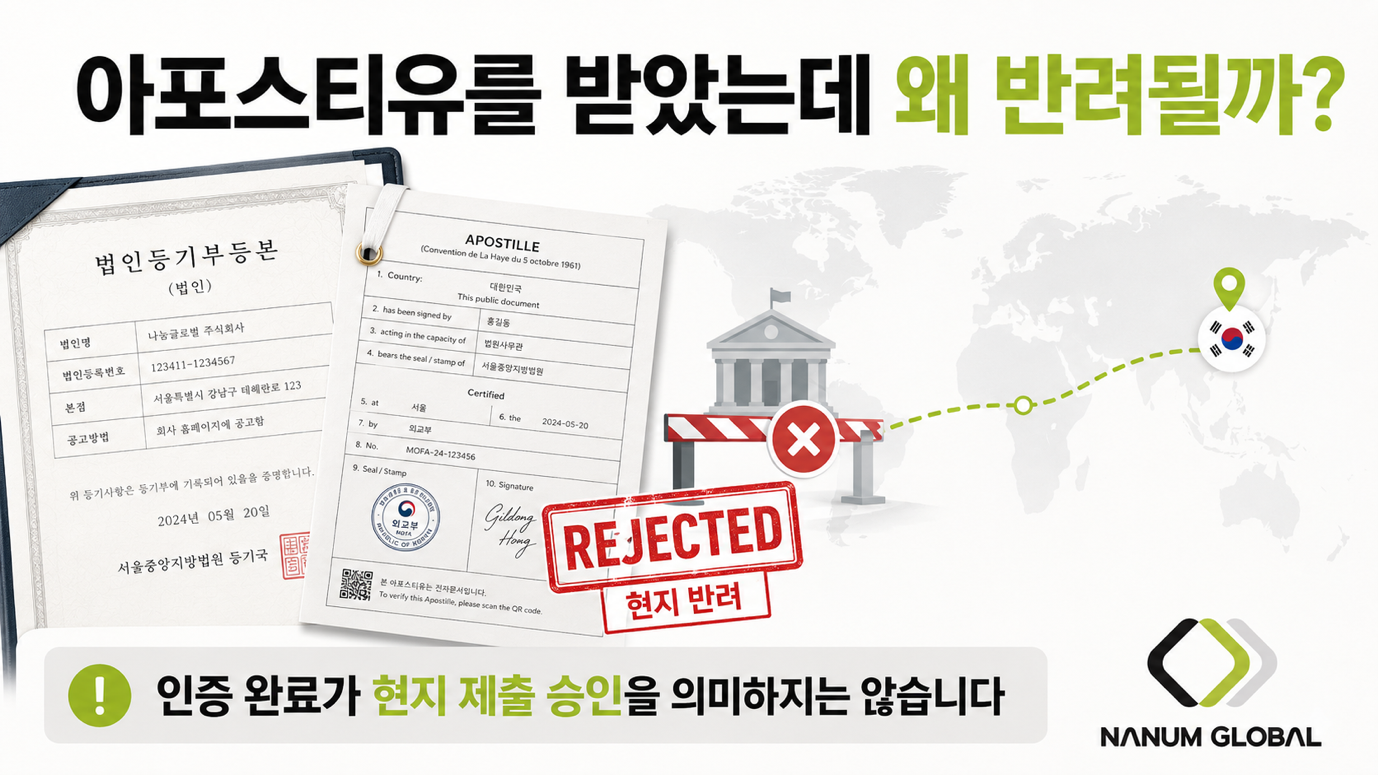
There are frequently asked questions. “I sent it with all the Apostilles, but they said it wouldn’t be accepted locally. Why is that?”
You will be embarrassed. If you went through all the procedures and it was rejected, you might be wondering what you did wrong. However, this happens more often than you might think. This is because Apostille does not guarantee everything in the document.
In this article, we will summarize the most common reasons for local rejection even after certification. If you know in advance, you can avoid the same thing.
First, what Apostille guarantees and what it does not
To understand the reason for rejection, you must first know what the Apostille confirms.
Apostille is a procedure that confirms that the document is truly a document issued or notarized by a public institution in Korea. In other words, it is a guarantee of the authenticity of the document. However, it does not confirm whether the contents of the document are what the submission party wants, whether the document type is correct, or whether it is valid at the time.
So, even if the Apostille is attached, if it does not meet the submission requirements, it will be rejected. You can think of certification as a confirmation of authenticity, not a certificate of passing.
First, when the translation does not exactly match the original
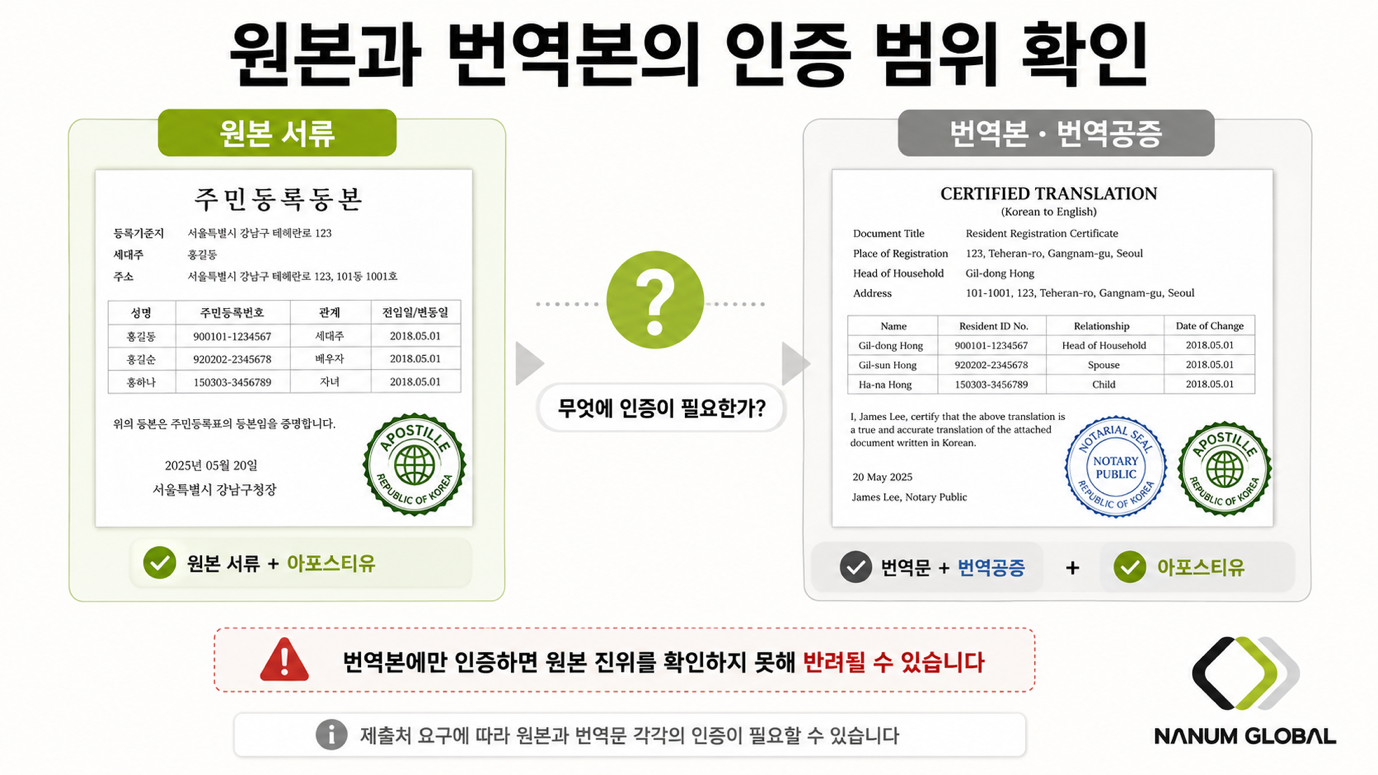
This is a common reason for rejection in documents requiring translation.
For translated documents, the translation and the original (or a copy of the original) are bundled together and notarized, and then the notarized document receives Apostille or consular authentication. In this case, the translation must exactly match the original. If the name, date, or organization name is translated differently from the original, or if some items are missing, it may cause problems locally.
In particular, there are cases where the proper noun notation is different from the passport, or the numbers and amounts are different from the original. If these errors are discovered after completion of certification, you will have to start over from the beginning, so it is important to check against the original during the translation stage.
Second, if the issuance date is old
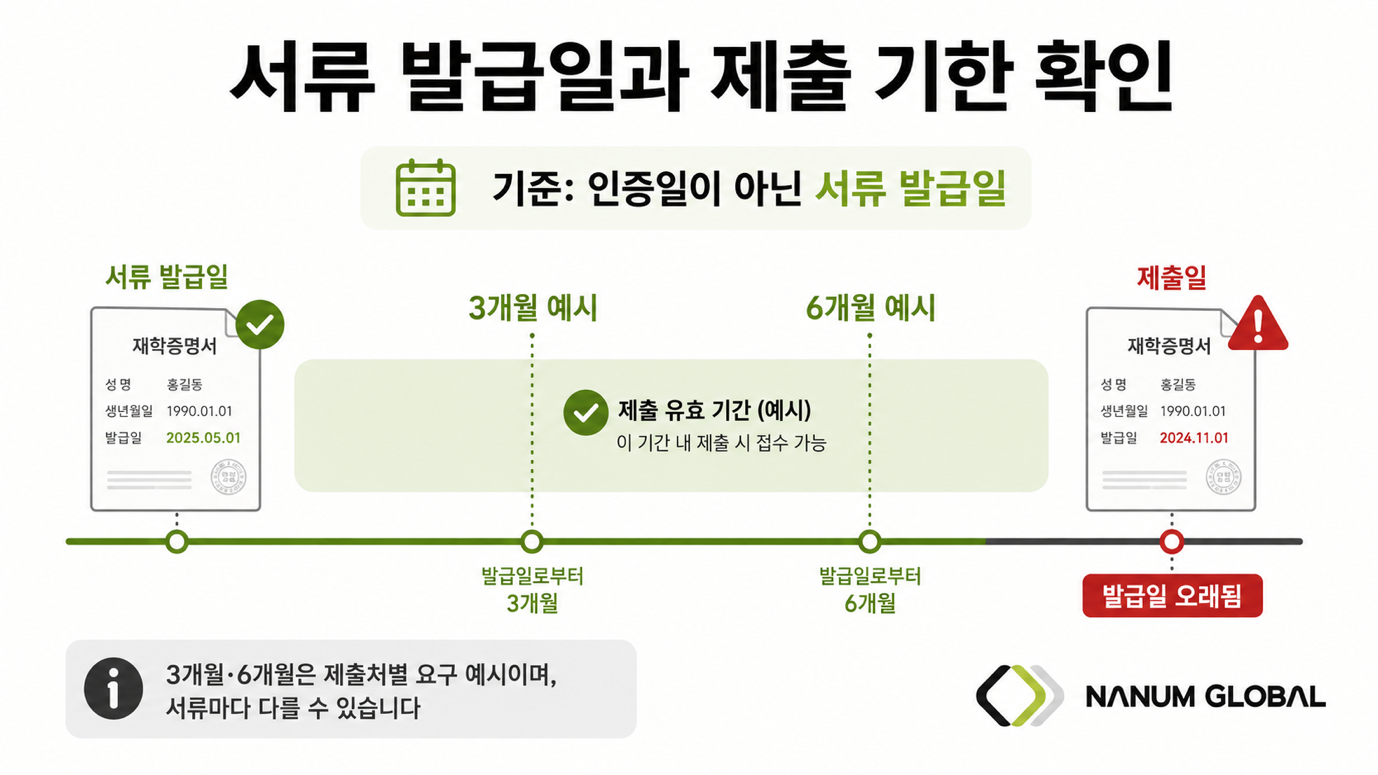
Documents may have a set expiration date.
For documents whose contents may change depending on the time, such as a family relationship certificate or criminal record certificate, the submission destination often sets a deadline such as within 3 months or 6 months from the date of issuance. If you submit a new Apostille on a previously issued document, the authentication may be recent, but the document itself may be old and therefore rejected.
When preparing documents, you must check the deadline based on the time of document issuance, not the time of certification.
Third, if it is different from the format requested by the submission party
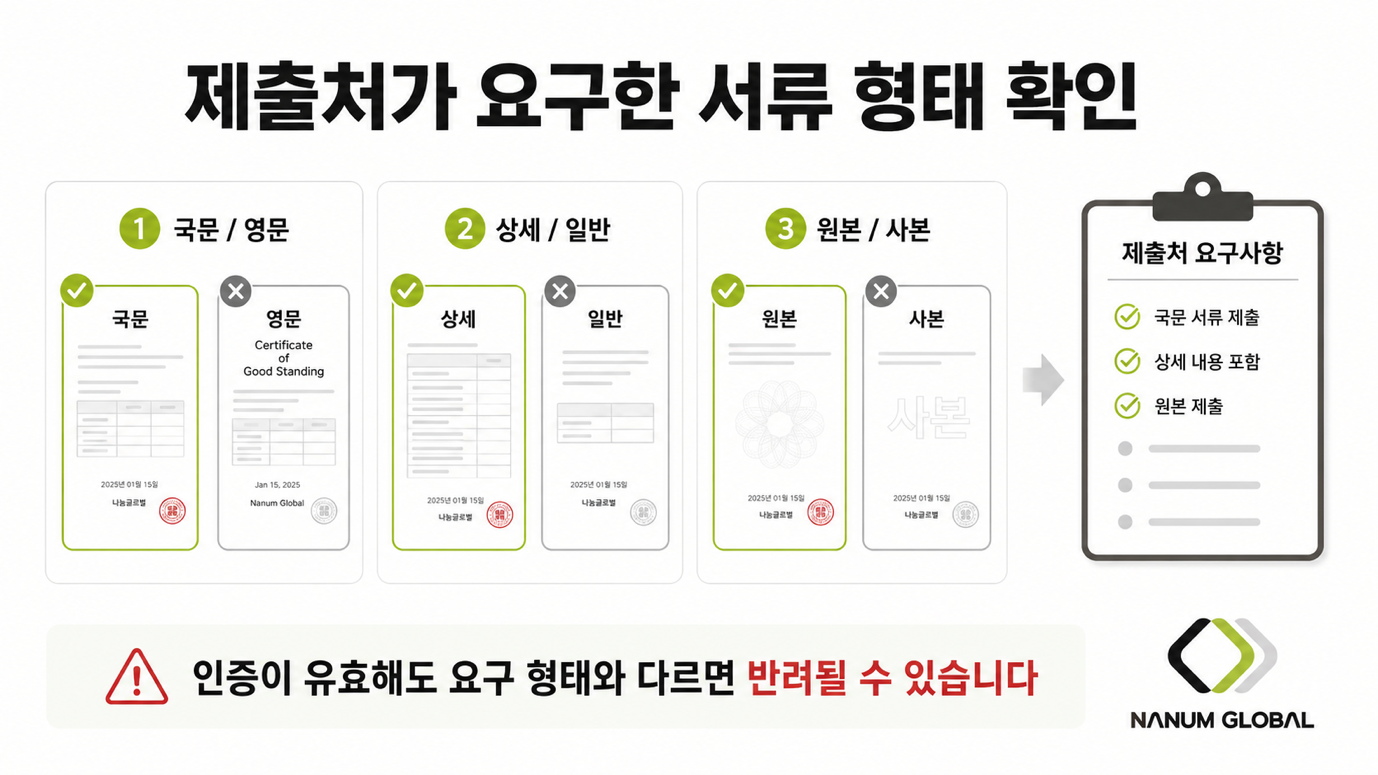
Even documents with the same name may have multiple forms.
For example, the documents vary depending on whether you submit the certificate in Korean or English, and whether you submit full details or only some of the details. If the submitter wanted a form containing detailed information, but was issued and certified in a brief form, the document will be rejected because it does not meet the requirements, even if the certification itself is valid.
Also, if the original is requested but a notarized copy is sent, conversely, there are cases where notarizing a copy is sufficient but sending the original does not retrieve the original. It's definitely a good idea to check first what format the submission party wants.
Fourth, if the status of the agreement is incorrectly judged
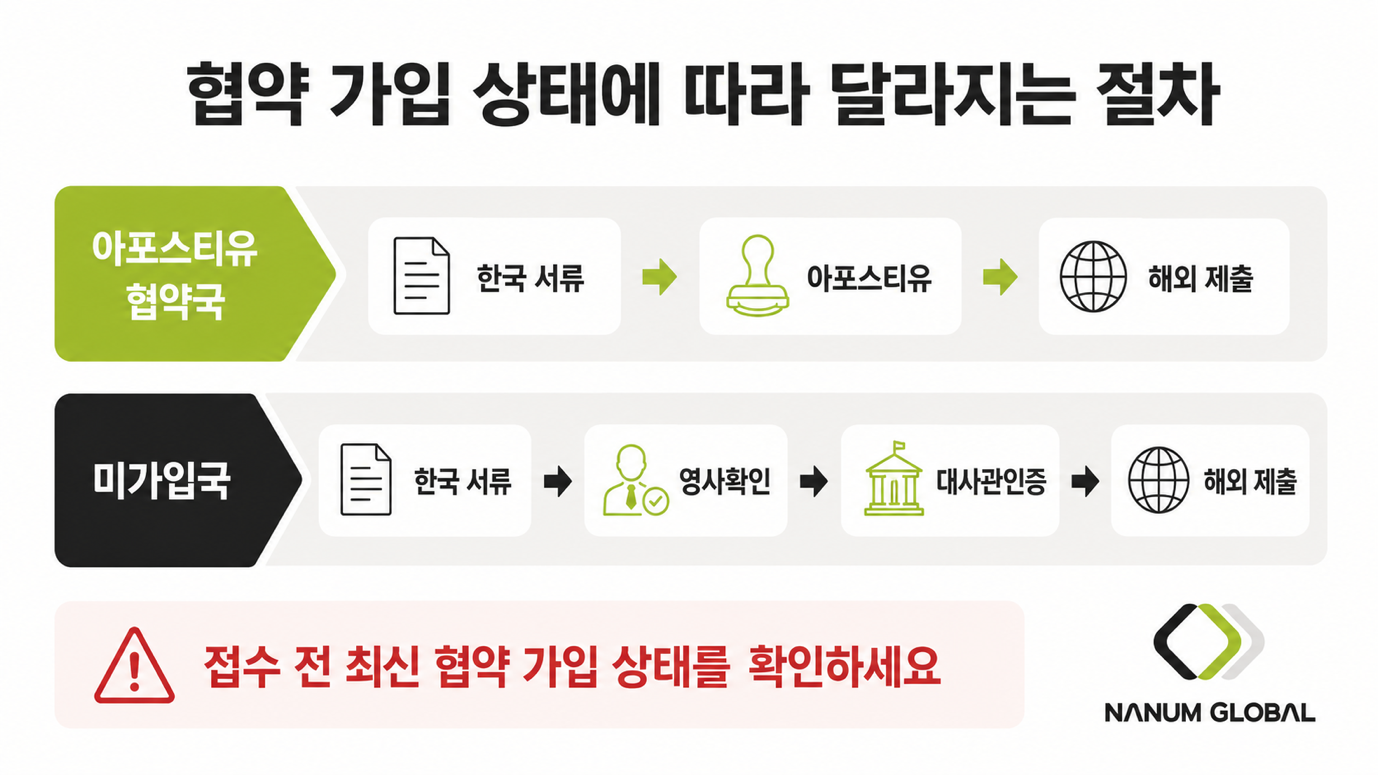
This is a case where you misjudged whether to go for Apostille or consular authentication.
If the country of submission is a country that has signed up to the Apostille Convention, it must be submitted by Apostille. If the country that has not joined the Apostille Convention, it must be submitted by consulate verification and embassy verification. However, the status of membership in the convention is not fixed and constantly changes. China will join in November 2023 and Vietnam will join in September 2026. On the other hand, UAE, Iraq, Iran, and Egypt are still non-member countries and require embassy authentication.
I prepared thinking it was a country that had received embassy authentication in the past, but it has already changed to Apostille, or on the other hand, I thought I only needed to receive an Apostille, but it was an unsigned country, and the documents will not be accepted.
Fifth, when one more step is needed locally
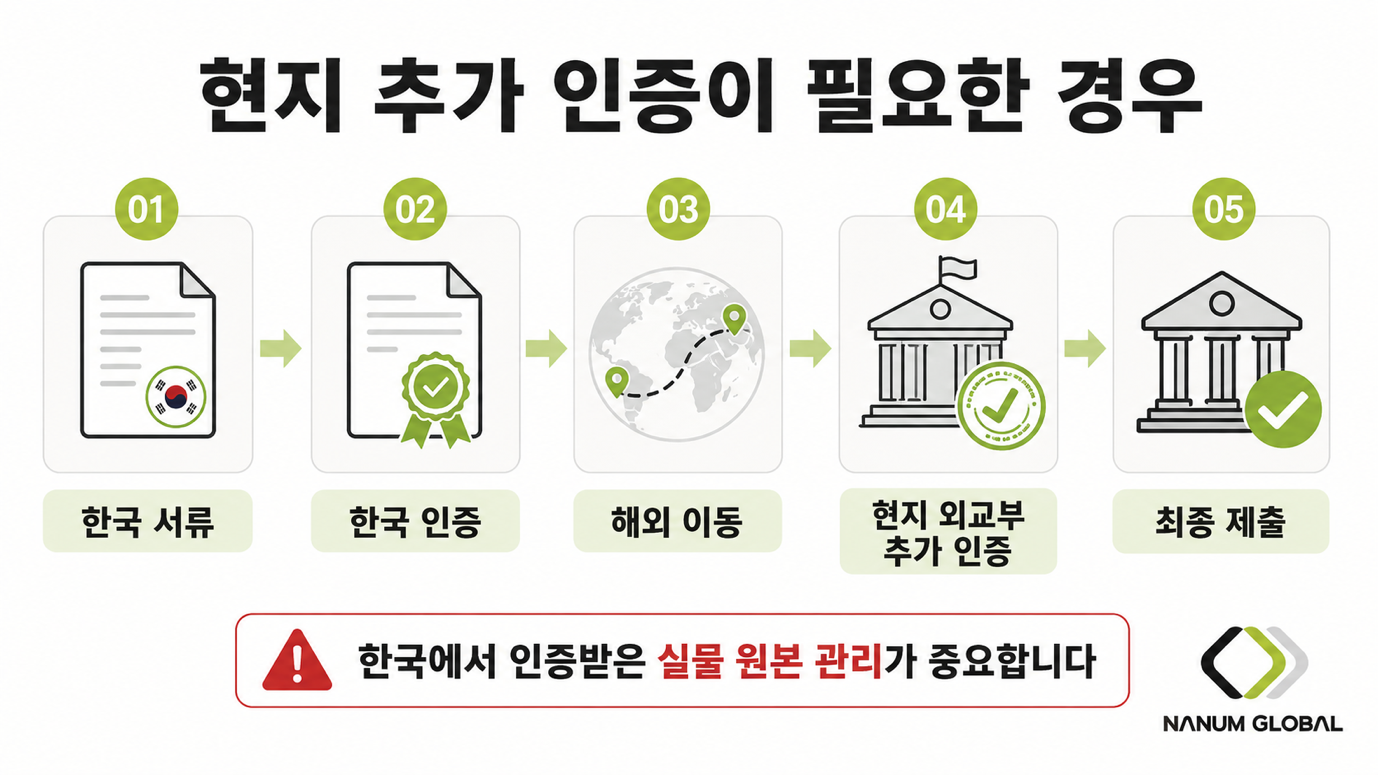
Even if all procedures are completed in Korea, there are countries that require additional local certification.
For example, in the UAE, even if you receive consular authentication from the Ministry of Foreign Affairs in Korea and authentication from the UAE Embassy in Korea, you often need one more authentication from the local Ministry of Foreign Affairs upon arrival. If you send documents without knowing this step, you may end up not being able to use them locally. In this case, you must have a physical original certified in Korea, so managing the original is also important.
To reduce rejection
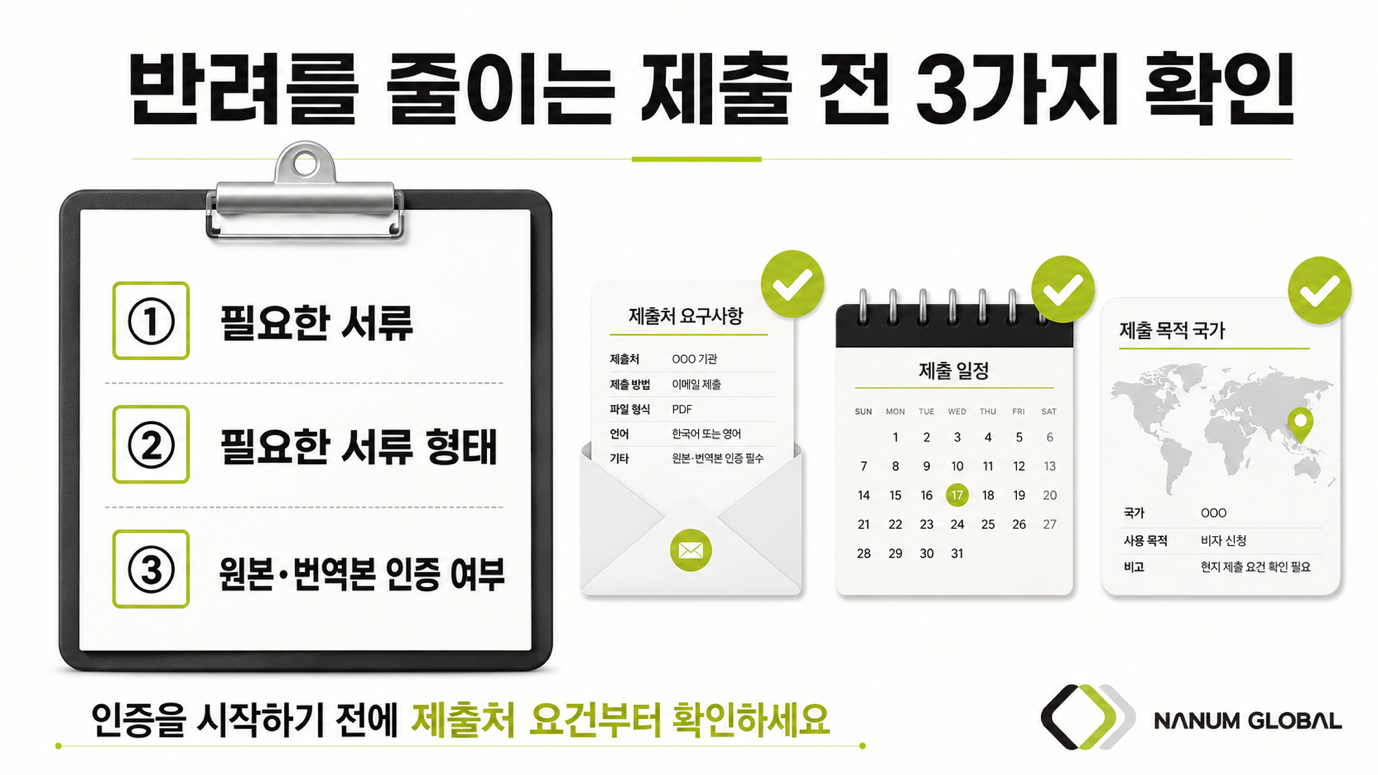
To summarize, the way to prevent pets is simple. Before starting verification, we check three things with the submission destination. What documents are needed, what format they are needed in, and if translation is needed, whether the original or the translated version requires certification. If you just check these three things, you can avoid most pet problems.
Frequently Asked Questions
Q. If you get an Apostille, won't it definitely pass?
No. Apostille is a process that confirms the authenticity of a document and is not a guarantee that it meets the submission requirements. If the document type, format, or time of issuance does not meet the requirements, it may be rejected.
Q. How are translated documents certified?
The translation and the original (or a copy of the original) are bundled together, notarized, and the notarized document is certified. Since the structure does not certify only the translation separately, you can check whether the original is included at the notarization stage.
Q. How do I check the document validity period?
In most cases, it is determined by the submission destination. You should check whether it is within a few months from the date of issuance, and make your judgment based on the time of document issuance, not the time of certification.
Q. If it is rejected, do I have to start again from the beginning?
It depends on the reason for rejection. If the form of the document is incorrect, you will need to obtain a new document and authenticate again. If only one step is missing, you may only need to supplement that step.
Q. What should I do if the submission site does not clearly inform me of the requirements?
It is best to check as much as possible, but it may be difficult in some cases. In that case, you can prepare it in the form generally required for the country and purpose. Please let us know the type of document and country of submission and we will guide you through the general requirements.
Conclusion
In most cases, the reason why an Apostille is rejected is not a problem with the certification itself, but a problem with document requirements and procedural judgment. The translation is different from the original, the issue date has passed, the format is different from what the submitter wanted, the status of the agreement was misjudged, or the local steps were not known.
Before submitting documents, Nanum Global checks in advance whether they meet the requirements for the country of submission and purpose, helping to proceed without rejection. If you have any documents that have already been rejected, please let us know the reason and we will advise you at what stage to supplement them. Please tell us the country of submission, type of document, and content of rejection notification.
Were your documents rejected locally?
If you tell us the country of submission, document type, and reason for rejection, we will guide you through the supplementation steps and re-certification procedures.


